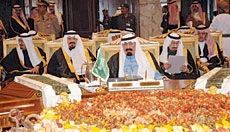
RIYADH, 10 December 2006 — Custodian of the Two Holy Mosques King Abdullah yesterday urged GCC countries to achieve economic unity.
“The dream of realizing economic unity should remain vibrant in our minds, because without unity we will remain small entities without having any influence and be influenced by others. But united we will be a power that cannot be ignored,” the king said.
He urged GCC countries to work for removing the obstacles that stand in the way of economic unity. “We don’t want to belittle these obstacles. Every member country has played a role in it. At the same the dream to realize economic unity should remain vibrant in our minds,” he said.
Opening the 27th GCC summit here, King Abdullah highlighted the volatile situation in the Middle East.
“It’s like a barrel full of gunpowder that could explode any moment with a single spark,” the king said, calling on the six-member Gulf Cooperation Council states to strengthen their cooperation in order to play an effective role in the region.
“Our Arab region is surrounded by dangers,” the king said in his keynote opening address. “Our basic issue of Palestine is still in the hands of a vicious occupying enemy that does not fear anything and in the hands of an international community that looks at the gruesome tragedy as a bystander.”
He decried the ongoing conflict among Palestinian groups, saying it would further weaken their cause.
King Abdullah also referred to the situation in Iraq and said he feared the current fighting between Sunnis and Shiites would slip into the darkness of strife and mad struggle.
“In Lebanon we see dark clouds that endanger the unity of the nation, threatening it to slide back again into a nightmare of conflicts between its various sectors,” the king said.
King Abdullah also referred to the problems facing the Gulf region.
“Many issues still remain unsolved and mystery revolves around some of the policies and visions,” he added. “In the light of all these problems, we have no choice but to remain unified and have a unified voice in order to support Palestine, Iraq, and Lebanon as well as other Arab and Islamic countries.”
He said the summit was an opportunity to review the achievements and failures. “Reviewing matters does not mean despair or giving up hope,” he said.
The king said GCC citizens expect more from the six-member group. “If we review our achievements according to the ambitions of our nations and what is necessary to achieve in this age, then we will reach the conclusion that all what we have achieved is still far away from the ambitions of our people,” he said.
He thanked President Sheikh Khalifa ibn Zayed Al-Nahayan of the UAE for chairing the previous GCC session and said that the current summit was named after the late Kuwaiti Emir Sheikh Jaber in appreciation of his contributions to the progress of the GCC that groups Saudi Arabia, Kuwait, Qatar, Bahrain, Oman and the United Arab Emirates.
“We still have much to do before we can say we have achieved complete economic union... the obstacles are real but we should not lose sight of the dream,” he said.
Before the start of the summit, a Gulf official said that Oman has informed the states that it would not join the monetary union in 2010, but could enter at a later stage.
“They feel they are not going to be ready by 2010... Rather than delay the process, they want the other countries to move ahead, and they can join at a later date,” said the official, who asked not to be named.
GCC Secretary-General Abdulrahman Al-Attiya said Friday that the GCC was proceeding with the 2010 preliminary deadline for the GCC vote, despite Oman’s request to opt out and join in again at a later date.
Oman had recently cast doubt on the timetable for the single currency project, suggesting other nations shared its concern.
The six countries have agreed to five criteria for a European Union-style economic union, including capping budget deficits at three percent of gross domestic product, capping public debt at 60 percent of GDP and inflation at the GCC average plus two percent.
Interest rates are to be no higher than the average of the lowest three states plus two percent and countries must have foreign exchange reserves to cover four to six months of imports.
The summit was also expected to consider a proposal made last year to limit to six years the stay of expatriate workers — a symbolic move that would pre-empt any international pressure to improve residents’ rights by granting them nationality.
An estimated 12 million foreigners live in GCC countries and make up more than 80 percent of the population in some cases.
The two-day meeting is also expected to discuss a US advisory panel’s recent report and recommendations on Iraq, a Saudi diplomat said, speaking on customary condition of anonymity. The Iraq Study Group, the bipartisan US commission, released a report Wednesday that called for the United States to engage Syria and Iran in a diplomatic effort to stabilize Iraq.
Saudi Arabia’s Foreign Minister Prince Saud Al-Faisal warned earlier this week that Iraq “poses a great challenge to the region, its security and its future” and called for “halting all forms of interference” an apparent reference to Syria and Iran.
Gulf countries also say they are worried about Iran’s disputed nuclear program. Iran is in a standoff with the West over refusing to suspend uranium enrichment. The United States and its allies allege Tehran is secretly developing nuclear weapons, and are pressing for sanctions against the country.