JEDDAH, 19 December 2006 — Saudi Arabia yesterday announced the 2007 national budget, the largest in its history with expenditures projected at SR380 billion ($101 billion) and revenues at SR400 billion ($106 billion), reflecting the growing strength of its economy. The Kingdom also disclosed that it would make a record budget surplus of SR265 billion this year and cut down public debt to SR366 billion by the end of 2006.
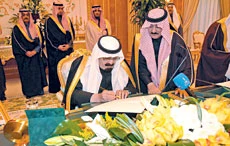
Custodian of the Two Holy Mosques King Abdullah, who unveiled the budget during the weekly Cabinet meeting at Al-Yamamah Palace in Riyadh, said allocations made for expenditures in the 2007 budget were SR45 billion higher than that of 2006 budget where expenditures were put at SR335 billion. He said the budget was prepared to meet the goals of the 8th Five-Year Development Plan and make available the necessary services required by citizens.
“The budget also aims at reducing public debt,” the king said in an address to the nation on the occasion of budget announcement. “By the grace of God, we have been able to pay back a large part of the debt to bring it down to SR366 billion by the end of the current fiscal year.” He said the budget contained new development projects worth SR140 billion, adding that the new projects would bring about balanced development all over the country.
In a statement on the occasion, the Finance Ministry said the king has allocated SR40 billion from the 2006 budget surplus for additional development projects and SR20 billion to increase the capital of Public Investment Fund (PIF).
“SR100 billion from the surplus has been transferred to state reserves and the remaining to pay off public debts,” the ministry said. The budget puts special emphasize on capital expenditures that will create more job opportunities and boost economic growth, the ministry said. It has allocated SR96.7 billion for education and manpower training, SR39.5 billion for health, SR15.5 billion for municipal services, SR13.6 billion for transport and telecom sectors, SR24.8 billion for water, agriculture and infrastructure sectors. Loans given by Real Estate Development Fund, Saudi Industrial Development Fund, Saudi Credit Bank and Agricultural Bank amounted to SR216 billion by 2006.
The ministry did not say what oil price it assumed for its 2007 budget, but economists said it appeared to be around $35 a barrel. The average price of Saudi crude will fall to $55 per barrel in 2007 from a projected $61 in 2006, the National Commercial Bank said on Sunday. The Kingdom’s gross domestic product (GDP) is expected to grow 4.2 percent in real terms in 2006 to SR1.3 trillion compared to 6.54 percent last year.
In his keynote speech, King Abdullah said the country would continue to focus on education and manpower training as part of its development strategy. “We are keen on meeting the requirements needed for raising the educational capabilities of teachers and improving their performance by introducing modern educational methods,” the Saudi Press Agency quoted the king as saying.
“We have issued our directives to increase the capacity of educational institutions,” the king said, adding that these institutions would focus on specializations required by the labor market. The 2007 budget has made allocations to establish and furnish 2,000 schools and to open four new universities in Baha, Tabuk, and Najran in addition to a university for girls in Riyadh. The existing universities will get 56 new colleges.
Allocations have also been made to establish 33 technical colleges and institutes and vocational training centers. “We have also made allocations for establishing and furnishing more than 380 primary health care centers and 13 new hospitals as well as for the expansion of several existing hospitals,” the king said.
Mohamed Ramady, professor of economics and finance at King Fahd University of Petroleum and Minerals in Dhahran, said the new budget was aimed at consolidating recent efforts to diversify the economic base of the country, with a particular emphasis on infrastructure building in the industrial cities and new economic zones to promote investment and build up technology-based education. “The emphasis on health and education is to be welcomed, as is the push for e-government and information technology, to ensure that Saudi Arabia can meet the challenges of globalization,” he said.
“What is also very significant, is the desire of the government to reduce the level of national debt, which now stands at around SR366 billion, or 28 percent of GDP, compared with the unsustainable levels of nearly 100 percent of GDP only a few years ago.” Ramady predicted that the domestic debt could be brought down to a negligible size within a few more years of budget surpluses. “The almost doubling of infrastructure spending to SR140 billion in the 2007 budget, from SR75 billion level in 2005, should also be welcomed by the private sector, given a recent slowdown in domestic activity following the fall in the Saudi stock market,” he said.
“Overall, it is a fairly balanced budget that is underestimating revenue growth while trying to keep a lid on unnecessary consumption expenditure, with continued emphasis on long-term capital investment and education,” Ramady pointed out.
According to the Finance Ministry, the budget surplus for 2006 is up 24 percent compared to the previous year. A near tripling of oil prices since 2001 has allowed the Kingdom to slash public debt, all of which is owed to local institutions from a peak of 119 percent of GDP in the late 1990s.
The private sector GDP is estimated to grow 6.3 percent in constant prices this year, the ministry said. Non-oil industrial sector is projected to grow by 10.1 percent, construction sector 6.3 percent, electricity, water and gas sector 5.5 percent, transport and communication sector 9.5 percent, wholesale, retail, restaurants and hotels 5.2 percent, finance, insurance and real estate by 5.1 percent in constant prices. “Private sector contribution to GDP is expected to be 44.8 percent in constant prices,” it pointed out. Inflation, as measured by the cost of living index, increased by 1.8 percent in 2006 while non-oil GDP deflator has shown an increase of 2.1 percent, the ministry said.
According to the Central Department of Statistics and Information, total exports of goods and services are expected to grow by 15.1 percent reaching SR808 billion in 2006. Nonoil exports are expected to grow by 10.8 percent to SR79 billion.
The Saudi Arabian Monetary Agency said the Kingdom’s trade balance was estimated to record a surplus of SR553.4 billion in 2006 with an increase of 17.5 percent. Current account is estimated to record a surplus amounting to SR358 billion in 2006 compared to SR337.7 billion in the previous year.
In 2005, the Kingdom had a balanced budget with revenues and expenditures projected at SR280 billion. It showed a SR50 billion increase in expenditures compared to the previous year. The deficit budget of 2004 put revenues at SR200 billion and expenditures at SR230 billion. In 2003 also the government announced a deficit budget with revenues at SR170 billion and expenditures at SR209 billion. The Kingdom posted surplus in 2000 for the first time in 19 years since 1982 as a result of substantial increase in oil prices. The actual revenues rose by 74.9 percent in 2000 to SR258.1 billion while expenditures rose by 28 percent to SR235.3 billion, creating a surplus of SR22.7 billion, which is 3.6 percent of GDP.