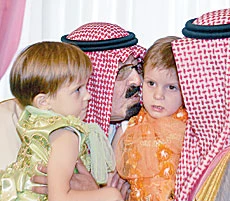
WARSAW, 27 June 2007 — Custodian of the Two Holy Mosques King Abdullah yesterday received the Order of the Smile during a ceremony at Belweder Palace. The children of the world selected him for the award in appreciation for his role in the separation of the Polish conjoined twins Olga and Daria Kolacz at a Riyadh hospital in 2005.
“We in Saudi Arabia were happy to host the Polish twins. When I visited them in hospital, I saw their beautiful smiles that strengthened my perception that our basic responsibility is to build a future of peace and security where our children can live happily without fears,” Abdullah said while addressing a banquet hosted in his honor by Polish President Lech Kaczynski.
“This is the goal for which I pray day and night and may God help us to realize it with other nations of the world,” the king said.
In his speech, Kaczynski supported the king’s views saying: “Peace is the most valuable thing in the world.” He said Saudi Arabia and Poland wanted peace to prevail all over the world including the Middle East.
Kaczynski thanked Abdullah for instructing a 50-member medical team at King Abdul Aziz Medical City in Riyadh to separate the Polish twins. The Saudi king paid the expenses for the complicated 15-hour surgery on the 17-month-old Kolacz twins in January 2005 when he was crown prince.
“The children chose King Abdullah because he showed through this act that the problems of children are close to his heart. He saved the life of Polish twin sisters, as well as other children around the world,” said Marek Michalak, founder of the Child Friendship Center, who presented the Order of the Smile award to the king.
Abdullah also received the twins and their mother, who thanked the king for giving her and the twins the best care during their stay in the Kingdom.
Abdullah is the first Saudi king to visit the predominantly Roman Catholic country. He arrived here on Monday and held talks with President Kaczynski and his twin brother Prime Minister Jaroslaw Kaczynski on major regional and international issues and ways of boosting bilateral ties.
The visit also witnessed the signing of five agreements to promote cooperation in the areas of security, education, health, science and technology and sports.
Kaczynski conferred on the king the Order of the White Eagle, Poland’s highest honor, and Abdullah reciprocated by awarding the president the King Abdul Aziz Medallion. King Abdullah also decorated the Polish prime minister with the King Abdul Aziz Sash of the First Order.
The Polish president described the king’s visit as an extraordinary event considering the Kingdom’s important position as the custodian of the two holy mosques and its political and economic weight in the Middle East and the world. “We have been waiting for this visit with great interest for quite a long time,” he added.
Before leaving Warsaw for Egypt at the conclusion of his European tour, the Saudi leader was briefed by Polish officials on the King Abdullah Center for Cultural Dialogue, which was established by the people of Poland in appreciation of the king’s gesture in separating the Polish twins. The king officially opened the center, which will promote dialogue between cultures and also teach Arabic.
The Saudi-Polish Business Council held a meeting in Warsaw on Monday with the participation of several business leaders from both countries. Fahd Al-Sultan, secretary-general of the Council of Saudi Chambers of Commerce of Industry, spoke about investment opportunities in the Kingdom and invited Polish companies to invest in the country.
King Abdullah later arrived in Sharm El-Sheikh, where he was received by Egyptian President Hosni Mubarak, Prime Minister Ahmed Nazif and other top officials. Foreign Minister Prince Saud Al-Faisal said the king’s visit has no connection with the four-party meeting of Mubarak, Palestinian President Mahmoud Abbas, Israeli Prime Minister Ehud Olmert and Jordan’s King Abdallah. Egyptian Foreign Minister Ahmed Abul Ghait said the king’s visit would help coordinate efforts to establish peace in the Middle East and provide an opportunity to discuss other major issues.