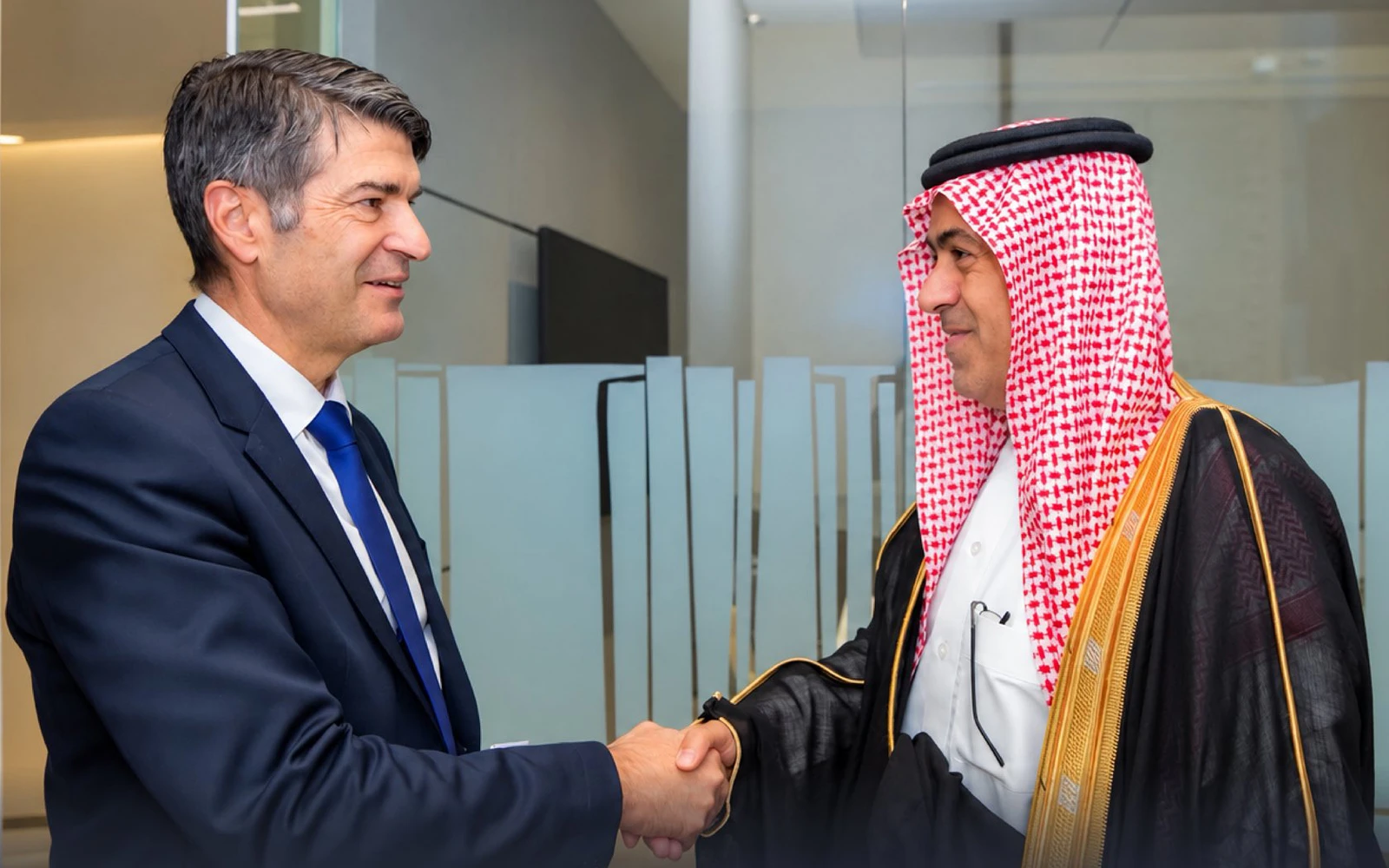
RIYADH, 27 June 2007 — India’s D.Y. Patil Group-Institutions of Maharashtra is currently negotiating with the Saudi Arabian General Investment Authority (SAGIA) for the setting up of a joint technical institute in Dammam.
Speaking at a press conference, Rajeev Shahare, deputy chief of mission (DCM) at the Indian Embassy said the D.Y. Patil Group-Institutions of Maharashtra has submitted its proposal to SAGIA for the setting up of the institute under a joint venture with Saudi entrepreneurs.
The group has over 75 schools and colleges in Navi Mumbai, Pune and Kolhapur, and has specialist programs in sciences, both in medicine and engineering.
The talks are still in a preliminary stage, but reflect India’s eagerness to share its technical expertise and know-how with the Kingdom, where multibillion dollar projects are in the pipeline.
Shahare also disclosed that India would be intensifying its drive to secure sub-contracts or joint ventures in the construction and IT sectors of the Kingdom’s planned economic cities.
I.P. Lakra, head of chancery, and Bishwadeep Dey, second secretary at the Indian Embassy, also attended the press conference.
Speaking further about India-Saudi relations, Shahare said a first batch of Saudi students would be leaving for India in the first week of July under the King Abdullah Scholarship Program (KASP). The first batch includes 101 students out of a total 138.
Shahare said their educational program in India falls within the framework of the Delhi Declaration signed during Custodian of the Two Holy Mosques King Abdullah’s meeting in January 2006 with Indian Prime Minister Manmohan Singh. The Declaration underlined the need for the enhancement of education in various fields at the postgraduate and doctoral levels, as well as the setting up of higher learning institutions.
The DCM said India can leverage its strength in the educational sector, since it has the second largest higher education network in the world with, among others, 343 universities, 40 agricultural universities, 36 technology institutes, 18 medical universities, 11 open universities, seven specialized universities for fine arts and languages, and five law universities.
Of the total number, 98 are deemed universities. There are universities focusing on journalism, social work, planning and architecture and other specialized studies. This is in addition to over 17,000 colleges, of which 1,800 are women’s colleges. Referring to the program lined up for the first batch, Shahare pointed out that the students — who include five girls — would be put through an orientation program in English in the first year before pursuing higher studies in various disciplines like IT, medicine, engineering, science and technology.
Asked if India was out of the loop in the Kingdom where it missed out on various multibillion riyal projects scooped up by China, Malaysia, France and other countries, Shahare said the country would explore opportunities in the construction, transportation and KBI (Knowledge-Based Industries) sectors in which it has a solid track record.
He also added that trade missions from various sectors will hold buyer-seller meetings in different parts of the Kingdom, while delegations from premier universities will mount road shows in Riyadh, Jeddah and Dammam to brief Saudi students on what India has to offer in the field of higher education.
There are several proposals under consideration from India for cooperation in the educational fields especially in the field of IT and technical education, Shahare said, adding that the broad thrust of the Delhi Declaration was to establish centers of excellence in the Kingdom.
Shahare explained that for the smooth implementation of KASP in India, the Saudi Ministry of Higher Education signed a Memorandum of Understanding (MOU) with Educational Consultants India Limited (Ed.CIL), a government of India enterprise, on March 31 this year. Ed.CIL will provide orientation classes to Saudi Students on arrival and also for their placement in English proficiency programs and other regular courses in various Indian cities, including New Delhi, Chennai, Bangalore and Coimbatore.