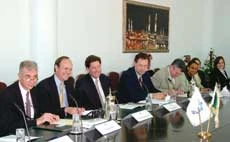
JEDDAH, 22 February 2007 — A US Congress delegation met with Saudi businessmen at the Jeddah Chamber of Commerce and Industry (JCCI) yesterday and discussed issues ranging from bilateral visa procedures, the US policy toward Israel and the Kingdom’s oil policy.
JCCI Chairman Saleh Al-Turki gave an overview of the booming Saudi economy and Jeddah’s growing status as a business center in his opening remarks.
“The JCCI is the biggest among Saudi chambers, with 50,000 members registered; some of whom play a major role,” Al-Turki said.
The JCCI board comprises 75 percent elected and 25 percent nominated directors. Four of its 18 members of the board are women — two elected and two appointed.
Al-Turki said the Kingdom’s economy grew 15 percent last year, three percent more than that of the Chinese. “We are currently in an era of mega projects and our oil production is aimed to increase to ten million barrels per day.”
The Kingdom has about two million illegal immigrants that are a burden on its infrastructure such as roads and health care.
Every year, three million pilgrims come for Umrah and one million for Haj from abroad and some half a million of them overstay their visas thus causing a burden on the economy.
“They affect all our activities,” he said, adding that the Kingdom has to spend $150 million to $200 million a year for deporting overstayers.”
“The Kingdom has seven million legal residents who repatriate billions of dollars to their countries. This is a major dent into our economy. However, the residents are beneficial to the Kingdom as they have been contributing to our economy,” Al-Turki said.
He said that Saudi families especially had been finding a lot of difficulty in getting visas for their children interested in pursuing education in the United States. “The stopping of the issuance of visas by the US Consulate in Jeddah has added to the problem as visa seekers have to approach the embassy in Riyadh, thus causing enormous delays.”
Bassem N. Houssami, political and economic chief at the American Consulate General, said the US mission had streamlined the visa procedure through the Internet and the waiting time for an interview for applicants, especially students, was now two weeks.
A member earlier pointed out that after the 9/11 event, the consulate did not allow the students enrolled in US universities to return (to the US) from their vacation break here. “The visa issue should take priority,” a Saudi businessman said.
Another member raised the issue related to the US support for Israel and said: “We’re frustrated with your role favoring Israel.”
A Congress delegate said this dialogue would go a long way in removing the bilateral misunderstandings and bridging some of the gaps. “We’re here to learn and understand more, although our State Department had given us an overview of the Kingdom,” Jameel Johnsson said.
“We want Americans to come here on a regular basis and you need to streamline your visa procedure for such visitors,” he said, adding that US businessmen find they were not able to explore business opportunities in the Kingdom as their Saudi counterparts were looking more toward Europe and the East. “We find the new city projects you are building now have European and Asian businessmen’s involvement but not American.”
A Congress member focused on the rising oil prices and said this was alarming as demand for oil worldwide was on the increase. “World economy grew four percent, that of the US 5.1 percent and Chinese 10 percent. So demand for oil is continuously rising.”
Those participating in the discussion were Anees Ahmed Moumina, Western region general manager of Samba; Mohamed M. Al-Mutlaq, Ibrahim A. Subai’e, Ghazi Binzagr, Ibrahim M. Al-Jumaih, Fahad A. Mughaire, Saud Al-Tuwaim, Saud Al Sa’ati and Mohanad Alsheikh, both of the Saudi Embassy in Washington, Sameer A. Ghunaim, Abdul Khaliq M. Saeed and Tarek Taher. The Congress team included Kenny Kraft, Joel Maiole, Dana G. Gartzke, John Goetchius, Semher Araia and Helen Hardin.