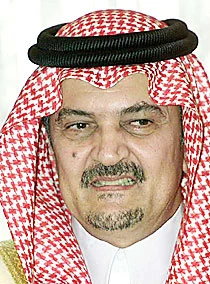
PARIS, 24 June 2007 — Foreign Minister Prince Saud Al-Faisal yesterday called on warring Palestinian groups Hamas and Fatah to stand united on the basis of the Makkah Accord to save themselves from self-destruction.
"The Palestinians have reached an abyss. Either they turn back or suffer the consequences of falling into it," he said. He also emphasized Riyadh's efforts in support of the Palestinian issue.
"We are working with the Arab League on this matter," he said when asked about the Kingdom's efforts to end the latest bout of Palestinian infighting. However, he pointed out that all efforts would go in vain if the Palestinian leaders themselves refuse to reconcile to protect their national interests.
Prince Saud made this comment while talking to Saudi editors and members of the Saudi media at the residence of Saudi Ambassador Mohammed Al-Asheikh in Paris. The foreign minister arrived at the venue promptly at the stroke of one, elegantly attired in a beige suit. He was in a relaxed mood despite a strenuous tour.
Prince Saud is part of the high-level delegation that is accompanying Custodian of the Two Holy Mosques King Abdullah in his current five-nation tour, which has already taken him to Spain and France.
Answering a question on the topics discussed in Paris, Saud said the Lebanese issue topped the list as Paris has taken the initiative to hold a dialogue between the Lebanese parties. Palestine also figured prominently, he added.
The Saudi foreign minister allayed Arab fears about a possible change in French policy toward Middle Eastern issues following Nicolas Sarkozy's assumption of office as the country's new president.
"During the talks we have not noticed any change in the French stand on Lebanon," the prince said.
He also noted the role played by France toward the passage of a UN Security Council resolution for the establishment of an international criminal tribunal to prosecute the masterminds behind the assassination of former Lebanese Premier Rafik Hariri.
Prince Saud said President Sarkozy had told King Abdullah about his desire to take Saudi-French relations to new heights. He also affirmed that France would remain a friend of the Arab world. "French policy has been consistent and hopefully it will remain so," he added.
Speaking about the Iranian nuclear issue, Prince Saud said: "Iran and Saudi Arabia are neighbors. Iran is a big and important country. The nuclear issue has created problems," he said.
Prince Saud expressed the Kingdom's worries that any fresh eruption of violence would affect the interests of all countries in the region. He also hoped that Iran would take into consideration the aspirations of countries in the region. "Saudi Arabia does not favor the policy of creating tension. But it favors the policy of peace," he added. He hoped that the international community would tackle the issue with wisdom.
However, the minister pointed out that the Western countries were adopting a double standard concerning nuclear arms. "Israel has a large nuclear arsenal and has not signed the nuclear Nonproliferation Treaty and it has created this situation."
Asked whether the king's visit to Egypt and Jordan had any relation with the meeting of President Hosni Mubarak, Palestinian President Mahmoud Abbas, Jordan's King Abdallah and Israeli Prime Minister Ehud Olmert in Sharm El-Sheikh, Saud said the royal visit was scheduled long before the four-way meeting was planned.
On the King’s Spanish visit, Saud said the talks in Madrid focused on social and cultural matters. Economic negotiations stressed the need for more private sector involvement.
Saudi Arabia and Spain agreed to set up a $5 billion investment fund to finance joint development projects in infrastructure, energy, new technologies, the defense industry and tourism mainly in Saudi Arabia, the Middle East and North Africa.
"Similarly in France the talks centered on furthering economic cooperation," the prince said. According to presidential spokesman David Martinon, King Abdullah and Sarkozy discussed major economic projects.
King Abdullah is scheduled to arrive in Poland on Monday on the last leg of his European tour. The landmark visit, the first by a Saudi king to Poland, will witness the signing of a series of agreements between the two countries. He will also visit Egypt and Jordan between June 25 and June 28 before returning to the Kingdom.