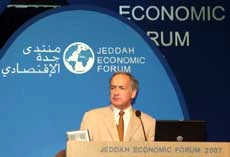
JEDDAH, 26 February 2007 — Saudi Commerce and Industry Minister Dr. Hashim Yamani yesterday emphasized the need for boosting the competitive ability of national production sectors. Speaking at the opening session of the eighth three-day Jeddah Economic Forum 2007 (JEF) at the Hilton Hotel, he said that the global economy was currently witnessing a very dynamic phase through direct interaction between world markets and great technological advances.
“Now is an opportunity for every nation to make gains from international competitiveness and work toward achieving better economic levels to meet the needs of current and future generations,” Yamani said in his address entitled “Enhancement of the Saudi Productive Sector’s Competitiveness in a Changing World Economy.”
Outlining the Kingdom’s strategy to develop the competitiveness of its production sectors, he said the application of current economic reforms was quite fruitful and productive.
The Kingdom has designed an ambitious and detailed program to update, simplify and rearrange investment policies and procedures in a manner that should help improve the investment climate, be it domestic or foreign. The idea is to enhance the competitiveness of the national economy in world markets. “The program objective is to place the Kingdom within the first and foremost 10 competitive nations worldwide by the end of 2010,” the minister said.
In the near future, the Kingdom will focus on developing an attractive investment environment, establishing economic alliances, updating information and communication technology, as well as encouraging investments in certain sectors, such as energy, transportation and knowledge-based industries.
The program of economic reforms adopted and being implemented now by Saudi Arabia has led to a notable enhancement of the competitiveness of the Saudi productive sectors. “It has provided the appropriate level of flexibility as to enable them to adjust effectively to the demands of the changing world economy,” the minister added.
“The reform program is, of course, ongoing and its focus will be shifted to implementing certain tasks in future,” he said. The tasks include continuing with efforts to create a favorable investment climate and providing investors with comprehensive services, encouraging investment in energy and transportation sectors as well as knowledge-based industries, upgrading the levels of information and communication facilities and services plus enhancing research and development in creative technology, and enhancing legal and regulatory frameworks of small and medium size establishments with a view to strengthening their competitiveness.
The other tasks include encouraging the merger of small establishments into larger ones and creating economic alliances among these establishments to promote their productivity and enhancing their efficiency, and establishing business incubators and thus fostering infant industries.
Yamani said the Kingdom had always been one of the leading participants in international trade. Its total trade is equivalent to two-thirds of its gross domestic product (GDP). In 2006, the Kingdom ranked the 12th largest exporter and 22nd largest importer of goods in the world. “The Kingdom is proud of its trade regime,” Yamani said. Transparency, predictability and due process are the cornerstones of its trade policy. Prohibited trade related investment measures and export subsidies do not exist. Corporate taxes imposed on foreign firms have been reduced from 45 percent to 20 percent with unlimited carry-forward losses.
What is more, the Kingdom and the GCC Customs Union have established a common external tariff with very low, stable, predictable and declining import duties complemented by the absence of quantitative restrictions. “However, it is the Kingdom’s successful accession effort to the World Trade Organization (WTO) that formally integrated it into the multilateral trade regime,” Yamani added. “The conditions for qualification to its membership led to the completion of many details in the reform program. Consequently, we have made a large number of commercially meaningful market access commitments on goods and services,” he said adding that while many existing regulations were amended, new laws were enacted with concrete procedures to implement the Kingdom’s WTO commitments.
In fact, the Kingdom enacted 42 new trade-related laws and regulations. Nineteen of them were required for WTO accession. These legislations addressed a variety of issues including customs valuation, import licensing, technical barriers to trade, anti-dumping, countervailing and safeguard measures, cooperative insurance, accredited private laboratories, foreign investment and capital market.
“I am also proud to say that as a full-fledged member of the TRIPS agreement and the Paris and Bern IPR Conventions, the Kingdom commands today the full and most updated laws and regulations related to intellectual property rights including those addressing trade marks, trade names, trade secrets, competition, copyrights, patents, geographical indications, industrial design, integrated circuits and border measures,” Yamani said.
“We are also working diligently on enforcing these legislations to combat piracy, eliminate infringements and substantially clear our market of fraud and fake goods.”
In cooperation with the Gulf Cooperation Council states, the Kingdom is also negotiating free trade area agreements with its major trading partners, he added.
Yamani emphasized that the Kingdom was pursuing its foresighted objectives set out by Custodian of the Two Holy Mosques King Abdullah and embarked on an ambitious program of economic reforms and restructuring. This is being implemented through four mechanisms — Streamlining the decision making process, expediting and enhancing the efficiency of the economic base, strengthening the role of the private sector and seeking the integration of the Saudi economy at the global level.
“Strategies for economic reform — universalism vs particularism was the theme of the first session, which was moderated by BBC broadcaster and presenter Sue MacGregor. Sami F. Bahrawi, chairman of JEF 2007, said in his opening remarks that for eight years in succession, this prestigious event has contributed to placing the Kingdom in its rightful place at the center of global socio-economic dynamics. “Reform is real and is a part of who we are.”
The environmental movie that was produced by Tariq Abdul Hadi Taher, which was part of the Jeddah Economic Forum program, was canceled at the last minute due to organizational reasons.