
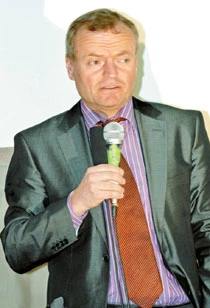
WHAT good parents and teachers know instinctively — that happy children make good learners — Professor Manfred Spitzer, internationally renowned neuro-scientist, has in effect proved. The effects of his discoveries and those of a band of colleagues in the esoteric discipline of neuroscience will without doubt cause controversy among instructors (rather than educators), the purveyors of computer games and the obsession with television.
In Jeddah recently, he delivered a lecture that covered the development of the understanding of how the brain functions and its effect on learning. The implications of his discoveries are far reaching insofar as they question and adduce evidence to the feeling that the way that formal education is conducted in the vast majority of societies is at best, not very effective. Disciplined education that causes anxiety at any level in the student is, he contends, decidedly counter productive. In his lecture he set out to prove it.
Professor Dr. Dr. Spitzer — to give him his full academic honorific — is the heavyweight’s heavyweight in his field. Doctor of Medicine and Philosophy, polymath and musician, challenging TV presenter and Medical director, professor and chairman (Head of Department) of the newly established Psychiatric Hospital at the University of Ulm (Universitätsklinik für Psychiatrie), Germany. In 2004 he established the Transfer Center for Neuroscience and Learning (Transferzentrum für Neurowissenschaften und Lernen [ZNL]), of which he is director. He frequently makes headlines with eye-catching assertions — for example that television is directly responsible for 20 thousand deaths a year in Germany alone — and then proceeds to explain with driving logic and experimental proof why he has made the statement.
With that many qualifications, one might expect an academic ogre. What you get is a perfectly mannered and very engaging man who is a lively conversational partner on a range of subjects. Put him on a stage in front of an audience, as he was recently at the German School in Jeddah, and he becomes the charismatic, witty and formidably enabled educator who holds an audience completely spellbound.
It is only about half way through a talk peppered with humor and wit that you realize that the very style and structure of the lecture is a demonstration of the point Spitzer has spent years researching and has now effectively proved; that if you are in a congenial environment and happy, you learn better. Obvious? Sure. But it was obvious at one time that the world was flat and the sun went round the earth. The difference is that Spitzer has, through the use of very modern technology and techniques, including MRI scanning, proved the obvious truth as true.
Spitzer starts there and applies to teaching techniques that are applied in schools the best neuro-scientific knowledge of how the brain works and what makes the individual happy; result, children learn better.
The significant points of Spitzer’s lecture were four: That the synapses in the brain (the chemical filled junction boxes that connect the neural network) develop more connections and improve their efficiency when used; that input solely from non- human sources — TV, video and audio teaching sources — is almost completely useless; that emotions affect the learning of skills and creative use of those skills in solving problems; that use of the brain makes it grow and become more effective. So sitting children in front of a television or games console as a ‘nanny’, stressing them emotionally while learning and testing them with memory tests rather than problem solving tests yields underdeveloped minds.
The connections between neurones (synapses) change in their strength when they are used. “This neuroplasticity,” said Spitzer, “is the most important thing we have learned about the brain in the last 15 years; the brain constantly changes when you use it.” He emphasized that the brain is the most use-dependent organ. “Many years ago — neurones were thought to be a fixed number; not so, right now they are growing.” He said that as many as 10,000 a day were formed in the short-term memory.
Spitzer gave the example of professional violinists; they have up to 20 thousand hours more ‘touch’ experience and have 4sq cm more brain area devoted to the left hand — they process more information coming in from the left hand. “They have no more cells, just connections.The brain’s hardware changes every day according to what the software is doing.” Sometimes neurones die — of stress — so it is important that new ones grow. Too much stress — they die off too fast and both brain and memory deteriorate.
Neurones constantly change their connections — leading to a phenomenon of the brain forming ‘memory traces.’ The path is use-dependent and the more a particular connection is used, the more permanent it becomes. Electrical signals travelling across synapses do the same thing — they build use-dependent paths. Once established — they get used more frequently; once they have been laid down they are hard to change — the more it is used, the better it gets and the harder to change it. “You had better watch what paths you lay out in the first place,” he warned, “because when they are there you are stuck with them.”
Spitzer contended that the learner could be told something that has an insight — learn something — but posed the question: How does an insight relate to learning? You can have insight without learning.” Conversely, he pointed out, when we learn our mother tongue we have no insights at all, “Yet you learned a complete language.”
He said, “What happens after the insight determines whether it will stick or not. You can have a ‘bad night’ and walk away without having learned a thing.” The point was that what happened after the insight is what determined whether the learning would stick or not. He gave a striking example. Two groups of children (one in the US, the other in Japan) with similar intellectual ability were given a lesson, delivered by video tape, on the use of fractions. As a follow-up and to put what the children had been taught to the test, in the US they were given work-sheets to practice with. “The class in Japan were divided into two and each half was asked to think of math tasks using fractions for the other half as homework,” Spitzer related. “So the kids talked math and fractions for most of the class.” The brains of the Japanese children worked harder — the synapses fired more frequently and longer — than those of the US children during the post-insight teaching.
“You have to make sure that a lot of things are going on in the child’s brain,” said Spitzer. “you have to do something with the content — eyes, ears and processing. If you force the content — nothing much will happen; if you get them to use it, then you get the big effect.” The results were startling. When both groups were tested on their knowledge of fractions some time later, the very worst of the Japanese children’s results was better that the best from the US children. “And no excuses about class sizes either,” said Spitzer. “The average US class was 25, the average Japanese 37. If you do it wrong, small class sizes do not help.”
Emotions and learning he has established are inextricably connected. A significant dampener of learning is often the amygdala — a small almond shaped organ in the brain that crudely processes external input and operates the ‘fight or flight’ reaction to it. It triggers an emotion — anxiety — in a person in the process. Spitzer said that one of the most important facts to emerge from his research was that you can learn when emotions — either good or bad — are involved. You can even learn with bad emotions.
The amygdala is a life saving organ — that’s why it has survived. “When switched on, it changes the way you think,” he said. “Anxiety — and creativity do not go together. The amygdala doesn’t allow the creative side to take over and analyze the potentials of threat. When you are anxious, you do not think creatively.” The essential point was that students learned in an anxious state, “then you also learn the anxious state; when you recall the learning, you recreate the anxious state.” Once the anxiety was recalled, the brain was no longer in a problem-solving mode. Teaching children while they were in an anxious state would not, he said, be useful for problem solving or for solving problems creatively. “Whoever you are and whatever you teach, do not do it when the learners are in a state of anxiety,” he said. “OK — so we don’t beat children now — but adult irony, cynicism and putting them down in front of other kids as we know creates anxiety.”
As emotions affected learning so did what he described as the ‘reward center.’ This area of the brain released chemicals that made the learner feel good when an unexpected reward was received. That explained why you only needed to eat one sweet red berry after trying many bitter green ones to remember that this was the sort to choose. Once learned however, the sweet red berry was an expected reward and the ‘reward center’ was not alerted because the required learning task was complete. “The real purpose of the reward center is to turbo-charge your learning of what is good for you. We did not know this until three years ago — but now it is clear,” he said.
Whether this confirmation as a scientific fact will be enough to overturn or even modify pedagogic practice ingrained into cultures over centuries is yet to be established. If not, then it may at least go some way to confirming the suspicion that many governments do not want a creative, problem solving and therefore less malleable populous and instead, “give them bread and circuses” — or at least television. What is clear however is that as far as your brain is concerned; if you do not want to lose it, use it.