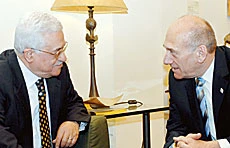
JERUSALEM, 16 April 2007 — Israeli and Palestinian leaders met yesterday for the first of a series of biweekly talks, addressing day-to-day issues such as travel and trade restrictions, but also talking about the general outlines of a Palestinian state for the first time after six years of paralysis in peacemaking.
“It was a good beginning,” Palestinian negotiator Saeb Erekat said of the two-hour meeting between Israeli Prime Minister Ehud Olmert and Palestinian President Mahmoud Abbas.
The next meeting will be held in the West Bank town of Jericho, marking the first time the two leaders come together in a Palestinian town.
Israeli officials emphasized that the two sides did not go into the key elements of a final peace deal, such as borders of a Palestinian state, the future of Jerusalem or the fate of Palestinian refugees
“We’re not going to be talking about the core issues of the final status at this stage, certainly not with the issue of terrorism not being addressed adequately yet,” said Israeli government spokeswoman Miri Eisin.
Israel says it will not address these issues as long as the Palestinian unity government fails to meet the international conditions for acceptance, including explicit recognition of Israel.
Erekat said the agenda was modest, but noted that it was the first time since the collapse of peace talks in 2001 that Israeli and Palestinian leaders raised broader issues, rather than just dealing with day-to-day concerns.
Yesterday’s meeting was the first in a series of biweekly meetings that Olmert and Abbas agreed to hold under prodding from US Secretary of State Condoleezza Rice.
Rice has urged the sides to move beyond day-to-day issues and begin discussions on the “political horizon,” referring to their ideas about a final peace settlement creating an independent Palestinian state alongside Israel. Abbas wants the talks to quickly move beyond day-to-day issues.
Eisin said yesterday’s talks were “very positive,” adding that the two leaders broke away from their aides and spoke one on one for more than an hour.
She said Israel raised concerns about rocket attacks and weapons smuggling in Gaza.
Eisin also said the two leaders discussed the “political horizon,” mainly on the “economic front.” She said Israel hoped to reopen Gaza’s Rafah crossing on the Egyptian border and expand the hours of the Karni cargo crossing between Gaza and Israel.
Erekat, the Palestinian official, called the meeting “frank.” He said Abbas urged the Israelis to do more to open the crossings, which are frequently closed due to Israeli security alerts.
Earlier yesterday, Olmert reiterated Israel’s willingness to hold talks with Arab countries on a 2002 Saudi proposal, renewed at an Arab summit in Riyadh last month, to offer Israel peace in return for a full withdrawal from territories it captured in 1967.