
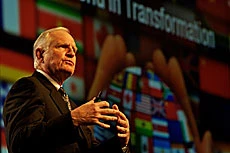
ALKHOBAR, 17 April 2007 — Today, Lebanon is set to welcome Intel’s Chairman Dr. Craig Barrett, who comes to the country in conjunction with Intel’s efforts as a founding member of the US-Lebanon Partnership Fund and its continuing “World Ahead” program. Through Thursday, Barrett has a packed agenda of business activities which encompass everything from donating equipment to several Lebanese universities to creating broadband links between health clinics in remote areas, plus teacher training and wireless broadband demonstrations. Intel considers its projects in Lebanon to be part of a long-term commitment to aid in the rejuvenation of this war-torn nation.
“This is not a quick-fix solution that we can implement in a few months and walk away from. We have to invest in the people to help take Lebanon forward, invest in the infrastructure that will support their needs and partner with government and public sector bodies to stimulate economic growth through the enhanced connectivity ICT brings,” said Barrett in a conference call from the US.
The Partnership (www.lebanonpartnership.org) is focusing on five key areas critical to creating sustainable economic growth in the country, which include crisis relief and response, information communication technology (ICT) infrastructure, work force training, job creation/private sector revival and connected government.
Currently, Lebanon is burdened by a nascent and inefficient ICT infrastructure. The Partnership has pledged to support development of an International Gateway and an Internet Exchange Point to Lebanon which will help develop Lebanon’s economy by enabling open communications in a competitive environment. The International Gateway will offer improved international Internet connectivity for Lebanon, and the Internet Exchange Point will strengthen local infrastructure to stimulate local economic development. This project has the potential to improve the speed and efficiency of Internet traffic flow throughout Lebanon and to help decrease costs.
Assistance also will be made available to the Lebanese Telecommunications Regulatory Authority in establishing an enabling environment for ICT in Lebanon that can promote innovation, investment and infrastructure development.
The Partnership is also concerned about sustainable economic growth in Lebanon which requires a skilled work force and businesses built to compete in a global marketplace. The Partnership is working to identify and place 500 Lebanese interns in Lebanon and the United States over the next three years. Members of the Partnership have initially committed to placing 115 interns within their own companies. Barrett stated that the first of the interns are already on the way to the US and four of them will be arriving at Intel’s offices this week.
“The goal of (this program) is to take Lebanese young professionals, give them work skills and insight consistent with what goes on in an international corporation, and let them bring those skills back to Lebanon and apply them to their daily work environment,” explained Barrett. “Whether they happen to be lawyers, business people or engineers, to give them the opportunity to work for a period of time, six months or so, in a professional environment where they can increase their professional skill base.”
While in Lebanon, Barrett will also be investigating the issues surrounding venture capital funding in the country. Intel does intend to make an announcement concerning the awarding of venture capital funds to a Lebanese business, but the reality is that the company is struggling to find viable regional companies in which to invest.
“We have committed to a $50 million venture capital fund for the region,” remarked Barrett. “It has been relatively slow in terms of uptake for a variety of reasons. The way we structure our funds is to look for viable business plans. Typically we are not in the mode of what I would call ‘Angel Funding’ or funding business ideas to turn them into plans. What we have seen is that there is not a large amount of what I would call venture capital infrastructure, basic seed funding to turn business ideas into business plans, where we then get involved in funding. So we are looking to modify some of our funding activities more toward back to the basic incubator level, the pre-business plan format, so that we can help facilitate turning some of those basic business ideas into viable business plans.”
The Intel chairman believes that the Middle East is full of intelligent individuals with bright ideas and entrepreneurial spirit, but he has found that the environment in the region doesn’t promote their success. Plus, young people in the Middle East too often don’t understand the methods of starting businesses, and finance mechanisms aren’t in place to assist start-up companies.
It’s not only the activities of Intel’s region-focused venture capital fund which are moving slowly. In Saudi Arabia, Intel’s planned venture capital initiative with the Saudi Arabian General Investment Authority (SAGIA), worth $100 million, is also lagging.
“That’s been a bit slow, not in terms of our commitment, but on really the infrastructure set up on the other side,” Barrett commented. “We continue to work and anticipate that the SAGIA structure will get put in place so that we can continue to work with them. But we have been waiting for their commitment and their movement on that space.”
In total, Intel has awarded less than ten percent of the venture capital funding it has earmarked for the Middle East. Barrett stated that it was “inappropriate” for him to comment on whether SAGIA is slowing projects or not.
“The devil is always in the details and the issue is whether we really get the ideas implemented on the ground. That’s the challenge that every country is facing,” he concluded. “The ideas are on the table and the technology capability is there, but how do you effectively use those tools, put them to work and create something wonderful out of them?”