
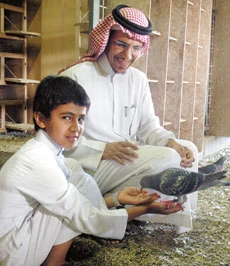
THIRTY-EIGHT-YEAR-OLD Saudi, Abdullah Al-Deghari, is an amateur at homing pigeon racing even though he has been involved in the sport for 16 years. Al-Deghari is from Qasim and became interested in pigeon racing as a hobby when the Saudi Federation for Homing Pigeon Racing (SFHPR) opened a branch in his town. He works as a director in the General Director of Education’s office, and is also the chairman of the Qasim Training Center for homing pigeon racing. In addition to this, he owns a farm which began with only two pigeons, and is now the home of hundreds of pigeons, and other wild animals including lions, wolves, and even snakes.
His ten-year-old son, Abdul Wahab, is following in his father’s footsteps and already has a pigeon that even sleeps with him. “The pigeon is always with Abdul Wahab, because he has taken care of her since she was eight days old,” he explained.
Al-Deghari is proud to be involved in pigeon racing. “When a particular pigeon, that you sent hundreds of kilometers away finds its way back to you, that is the reward from pigeon racing,” Al-Deghari said, adding that a great deal can be learned from observing pigeons. They are not only very loyal; they are also surprisingly intelligent as well. For them, loyalty is always the determining factor. “No matter where pigeons go or what they have been through, they always find their way back home. For some, pigeons are just birds, but homing pigeon amateurs feel differently. Something moves inside the amateurs’ hearts when their pigeons come back to them,” said Al-Deghari.
The SFHPR was established in 1992 and joined the International Federation for Homing Pigeon Racing a year later due to the efforts of Prince Abdul Rahman ibn Abdullah Al-Faisal. “The prince was the first supporter, both emotionally, and financially and has dedicated many hours of his time which encourages others to do the same,” said Al-Deghari.
Homing pigeons were used in the Abbasid Empire (758-1258) to carry messages between Basra, Damascus, Baghdad and Makkah but now they are kept for fun.
Amateurs buy their birds and separate them from their parents after only 25 days. This makes the birds dependent upon the keepers for food. The birds are put into special cages with an open door and left there for four hours a day over a four-day period. At the end of the four days, they are released. “We do not worry about losing them because usually they come back even if it takes a whole day. If they were released at a younger age, they might not return because age is critical to their psychological development. In order to make them feel warm and calm, amateurs hold their pigeons by their feet, aligning the pigeon’s chest with theirs,” explained Al-Deghari.
Raising pigeons is something which might take some a few months to master while others might need years to catch on. “The more you engage in it, the more you learn to enjoy it,” Al-Deghari said. An experienced pigeon trainer will know how to test a pigeon with his fingertips. The owner tests the pigeon’s breast and stomach muscles, the bone which connects its wings to the rest of the body, and the wings themselves, to see if it can endure a race or not. Before allowing a bird to race, a trainer must consider the length of the race in relation to the bird’s body strength.
Pigeon racing has become easier since the year 2000 when the SFHPR provided an Electric Timing System which has a clock connected to one or more antennas and an electric chip ring which is carried by the pigeons. When the bird returns home from a race, it crosses an antenna and the serial number of the chip rings, along with the time of arrival; both are recorded and the average speed is displayed.
Speaking of difficulties and possible problems, Al-Deghari said that feeding the birds always comes first. Next, unstable weather conditions and finally, avian flu — the much-publicized “bird flu.” Thus making it especially difficult to import or export pigeons.
However, raising pigeons provides an opportunity to mix different types of locally-bred pigeons with other pigeons and by doing this carefully, a new and improved breed of pigeons is produced. He is also working on breeding a special pigeon that might be named after him.
Amateurs should also be careful when feeding their pigeons. The birds require plenty of protein and fat before a race, even if the two are given to them only four days in advance. Al-Deghari explained, “During the race they burn a lot of calories, their muscles weaken and the fat and protein strengthen them. When they finish the race, they are more likely to eat light foods such as corn or cooked rice because they are exhausted, and have no energy spend on digesting heavy foods. It is interesting that birds being trained for racing do not mate. They are prevented from mating so that they will not be exhausted when it is time for a race. “We allow them to mate as a reward after they finish the racing season,” he said.
An outstanding competition, according to Al-Deghari, was a 900km race held in 2003. His birds won the first six places which gave him the Prince Abdul Rahman ibn Abdullah Al-Faisal Cup in Qasim. “Amateurs are allowed to use as many pigeons as they want. It is difficult to choose which pigeon suits which race, but taking risks is part of the fun. I was lucky, and I thank God that they all came back to me,” he said. He also won first place in 2004, in the Sakaka and Qurayyat City Competitions, and twice this year in Al-Shuaibat. In addition, he participated in the International Pigeon Racing Competition in Portugal in 2003, 2004 and 2005.
People who keep racing pigeons usually have a few tales to tell and Al-Deghari is no exception. A woman came to him once to buy 10 pairs of pigeons from his farm. The price came to SR2,000 and he was shocked to learn that she was not planning to race them but to cook them for her children. “I suggested another place where she could buy that number of pigeons for only SR200.” Another amusing incident which might have ended badly occurred when some thieves tried to steal some of Al-Deghari’s pigeons. They got into the enclosure where the birds are kept but were unable to leave. The watch dog held them captive until morning. A few days later, another thief came and tried to befriend the dog by giving it a piece of meat but fortunately, this thief was also unsuccessful.
Many people who keep racing pigeons are retired. The sport does not require an athlete’s body — just commitment, devotion and time. “Society is unaware of this ancient Arab hobby because the media neglects it even though some races involve 1,500 to 2,000 pigeons. I wish the media would sponsor some of our events,” Al-Deghari said. He has presented an idea to the director of Students’ Activities that 40 students of different age groups attend one of the events. “This will acquaint them with what is going on and some of them may become interested enough to take up the hobby.” He said it was important that the students be aware that it was not a hobby to be taken up today and dropped tomorrow. They should be introduced to it by people who are dedicated, informed and who know a great deal about the birds and racing them.