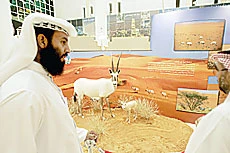
RIYADH, 23 April 2007 — Dozens of local and international-specialists in the fields of zoology, wildlife, hydrology and animal protection have gathered in the capital to speak about the natural habitats and challenges faced by the Arabian Oryx — an endangered species peculiar to the Middle East.
The Honorary President of the Saudi Biological Society and Minister of Agriculture Fahd Balghuniam — on behalf of Crown Prince Sultan — inaugurated the event entitled “International Conference on the Arabian Oryx in the Arabian Peninsula” Saturday evening.
The Saudi Biological Society and the National Commission for Wildlife Conservation and Development (NCWCD) organized the three-day symposium.
“The efforts of the government of the Kingdom of Saudi Arabia in preserving natural habitats has extended the local borders to reach out to the international community where it is cooperating with international agencies and institutions to preserve the environment and natural resources,” Prince Sultan said in his speech, which was read by the minister.
Crown Prince Sultan also mentioned that the government was keen to preserve the natural habitats for wildlife as part of the basic ruling of the Kingdom.
“Success in confronting the challenges that face natural habitats on a local and international level requires extensive cooperation between government, private, and civil institutions,” he said, adding, “It extends beyond international borders and implies the importance of human existence on the face of the Earth.”
The crown prince added that among the several government efforts to preserve natural wildlife habitats in the Kingdom was the government’s efforts to reintroduce the Arabian Oryx as well as other endangered species in their original natural habitats in Saudi Arabia.
The Arabian Oryx is an endangered species. Its natural habitat was the Arabian Peninsula for thousands of years. According to the NCWCD, due to random hunting the last wild Arabian Oryx was probably killed in Saudi Arabia in 1972.
Its death became a symbol of human destruction of the natural world. The capture of a few of the last wild Oryx in 1962 marked the creation of the “world herd.”
Through captive breeding, first herd returned to the wild in Oman in 1982.
The restoration of the Arabian Oryx population was initiated by the NCWCD in November 1988 with the translocation of the Oryx to the Mahazat Al-Sayed Protected Area — a 2,244 square kilometer desert step habitat near Taif.
Between 1990 and 1994, a total of 76 Oryx were released into the protected area. Another eight Oryx were released in March 2005.
Natural reproduction brought the estimated size between 650 and 700 by December 2006. Since the project began, 890 births have been recorded in the protected area (20 in enclosures and 870 in the wild).