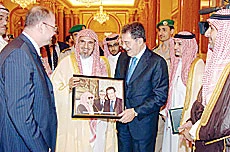
RIYADH, 23 April 2007 — Addressing members of the Shoura Council here yesterday, Italian Prime Minister Romano Prodi reiterated his country’s willingness to participate in all sectors of the Kingdom’s development plans. He praised the Kingdom’s efforts to bring peace and prosperity to the region.
“The Kingdom of Saudi Arabia has played a major role in dealing with international issues and this has raised its profile internationally. We enthusiastically support the Kingdom’s efforts,” he said. As an example, he cited King Abdullah’s stance on issues such as Lebanon, the occupied Palestinian territories, Iraq and stability in the Gulf.
He lauded the Kingdom’s initiative in inviting Palestinian groups to Makkah which paved the way for the formation of a unity government.
Prodi said that his talks with Custodian of the Two Holy Mosques King Abdullah and Foreign Minister Prince Saud Al-Faisal were fruitful, but added that there still remained many challenges for the region to confront. Aside from the Arab-Israeli conflict, there were new challenges which included the possibility of nations using technology for military use, sectarian strife in the Islamic world and misunderstandings between the Islamic world and the West.
He said that dialogue was the only means for resolving “the great threat of terrorism” which stems from extremism and intolerance.
The Italian prime minister said that the relaunch of the Arab peace initiative at the Arab summit Riyadh recently opened “doors of real hope for peace and prosperity for all nations in the region, including the Palestinian people.”
He called on Syria to play its role in the Middle East, saying that the European Union — with contributions from Italy — had adopted a “new stance on Damascus,” urging the Syrian leadership to seize new opportunities for peace.
He warned of the consequences of fighting among rival Lebanese political parties, saying: “We cannot allow Lebanon to slide into another civil war.”
The prime minister said he was “deeply saddened” not only to see the daily bloodshed in Iraq as a result of the sectarian violence, but also to realize that his advice on Iraq “fell on deaf ears.”
Another topic discussed was Iran. Prodi said the situation was “worrying” because of Tehran’s nuclear program and also because of differences between Sunnis and Shiites.
He ruled out the option of military confrontation to resolve the problems, saying that it would be “unacceptable and would have negative effects.” Dialogue, he said, was the only way to reach satisfactory solutions.
“I refuse to think that two great civilizations — the Arab and Persian — which are both inheritors of great cultures cannot find a common ground for dialogue,” he said. The Italian prime minister later held a closed-door meeting with Shoura Chairman Sheikh Saleh Bin-Humaid and several members.
Prodi later flew out after concluding a two-day visit to the Kingdom. The prime minister also met with Crown Prince Sultan, deputy premier and minister of defense and aviation, and Saudi businessmen in the city. He also held discussions with the Saudi Arabian General Investment Authority (SAGIA) Gov. Amr Dabbagh.