
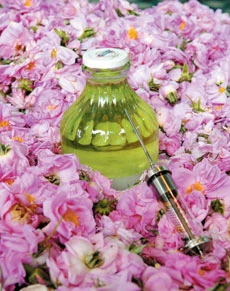
THE sense of smell is perhaps the most evocative of all our senses, instantly stripping away years and triggering memories like no other. For many, the scent of freshly cut grass flashes images from childhood into the mind’s eye; for others the life-filled smell of wet earth after rain stirs deep memories. Without doubt, the signature scent of Arabia is Attar of Roses and the most sought after variety of the perfume comes from Taif.
Tucked into the cool 2000-meter escarpment in Shafa — The Edge — near Taif lie small gardens where the force of the rising sun is delayed by the jagged peaks above. Moderate temperatures, plentiful water and good topsoil combine to make perfect growing conditions. Before dawn, teams of Indonesian and Bangladeshi pickers are harvesting the light pink intensely aromatic blooms of the oil-rich 30-petal damask rose (Rosa x Damascena trigintipetala). It has been cultivated for over three hundred years in Taif by small market gardeners as a commercial crop for the production of that most fragrant of all perfumes, attar of roses and the even older by product, rose water.
Attar — derived from the Arabic ‘itr meaning perfume or essence — is the essential oil distilled from roses. Extracted from fresh blooms either by steam (when it is known commercially as Rose Otto) or by solvent extraction or supercritical carbon dioxide extraction (Rose Absolute), it has been single-distilled since the 9th Century when Persia became one of the earliest producers. By the 13th Century, it was widely produced in Syria. True attar-rose oil as we know it was not produced until the late 16th century, when the process of double-distillation was developed.
How the distinctive Taif rose first arrived in the region is still unclear. However, the proximity of Taif to Makkah was certainly a contributing factor. The oil distillers arrived about two centuries ago as producing oil close to source blooms made for more efficient production and greater yields from fresh plucked blooms.
Pilgrims to Makkah diverted to Taif to buy a tolah — named from the weight of the oil in a vial which is about 12 grams — as a souvenir of their Haj. Centuries later, Taif rose oil is the preferred scent used by the Haj authorities to perfume the Yemeni Corner of the holy Ka’bah in Makkah’s Grand Mosque. In daily life, rose-water sprinklers, usually made with long straight necks and bulbous bottoms, have a long established role in festivities in much of the Muslim world. At the conclusion of a wedding feast rose water is usually sprinkled on the hands and faces of guests.
The rose oil produced in Taif is, though small in quantity, of extremely high quality. Its potency and price are so high that a gift of rose oil is seen all through the near and far east as one of the highest compliments it is possible to pay.
The Taif rose strain is very close to the Bulgarian “kazanlik” strain; possibly they were introduced from the Balkans by the Ottoman Turks, who occupied the Taif area from the mid-14th century and the Hijaz from the 16th century.
The painstaking process of gathering and distillation makes the production of rose oil in Taif a small and intensely family-based affair. The gardens of Maqboul Al-Talhi in Al-Shafa have been in his family for generations. Out early in the morning with his workers, he constantly plucks test blooms to test the potency of the aroma. Wide diurnal rhythms of temperature fluctuation and clear skies combine to produce regular dews and this encourages the roses to build a workable quantity of oil. “It is vital we have the fields picked before nine in the morning,” he explained. “After that the scent has lessened to the point where the quality and therefore the price of the blooms drops.” The Al-Gahdi family factory — still run by the two brothers who started work in it over 50 years ago — will not accept blooms after 10 a.m.
The height of the picking season is usually the third week of April. The picking itself is something of a race between the pickers, the sun and the bees that by 8 a.m. are out in force to gorge on the fresh pollen.
A well-established bush that can stand 1.8 meters and be two decades old might carry 200 blooms. Well tended and fertilized and pruned in December, the bush could produce 3000 blooms in the maximum three-month season. It needs to.
The numbers of roses needed to produce the distilled rose oil varies with the quality of the rose. However, it takes between 14,000 and 17,000 individually plucked blooms to produce one tolah of oil. As soon as the blooms are plucked, they are taken in sacks from Al-Tali’s gardens to the factory. There, in a patient throng of growers each keen to have his crop weighed, the blooms are emptied onto the floor, swept up into baskets, weighed in an ancient beam balance and recorded faithfully in an old exercise book by Abdullah Al-Gahdi.
The roses go then to the factory floor where, loaded into woven rush baskets they are loaded into gas-fired boilers with water for the first distillation. There they simmer for up to seven hours, steam collected by a mushroom shaped cap sealed to the boiler and with a downward angled pipe leading through a water bath. Here the distillate condenses and is gathered in containers and begins to separate into rose water and attar. The yield of the first run is low as much of the oil is dispersed in the rose water — al-arus, or “the bride.” The arus is redistilled — usually by recycling it onto a new batch of flowers where it extracts a greater percentage of the essential oil than plain water can. The attar is allowed to stand for several days as the impurities precipitate out. The attar is a bright olive green in its concentrated bulk form and the arus a milky white. A week’s production of oil in this busy factory is just half a litre. It is, weight for weight, much more than gold at SR83 per gram. One tolah of oil can fetch, depending on quality, season and demand, SR100/150 per gram.
The rose water is a by-product and diluted for sale as flavoring and medicinal purposes — traditionally used for stomach ailments and treating minor eye infections -and enjoys huge popularity throughout the Middle East. In a strange ironic twist, the production of rose water was the original reason for boiling roses — the attar was the later b- product.
Almost all the attar of roses produced by the Al-Gahdi factory is exported, the bulk to the United Arab Emirates. The rose water can be found on general sale in supermarkets across the Kingdom. That simple clear fluid, looking as it does like nothing more than scented water, is the end product of a process of cultivation and tradition stretching back over centuries, guarded by generations of growers — and alive and well in Taif.