
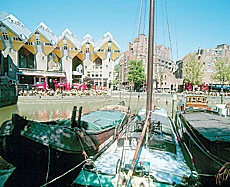
Dutch culture is diverse, reflecting regional differences as well as foreign influences. This is attributed to the merchant and exploring spirit of the Dutch. The architecture of the Netherlands has been developed accordingly.
Early Dutch architecture was influenced by a Calvinist ethos of uniformity and sobriety. Only the wealthy merchants built fairly modest yet stately canal houses in Amsterdam. Therefore, Dutch cities lack the grandeur and flamboyance of Paris and London because the government preferred ordinary buildings.
Contemporary Dutch architecture is more cosmopolitan. During the 20th century Dutch architects played a leading role in the development of modern architecture. In 2000 the International Union of Architects put together a list of the 1,000 most important 20th century buildings in the world. This prestigious list boasts no less than 13 buildings in Holland, four of which are located in Amsterdam.
Different architectural movements developed. The expressionist Amsterdam school and the Stijl architects of the 1920s were inspired by international art movements. Modernism became the principal style of the post-World War II housing boom. The city center of Rotterdam is a typical example. Since the early nineties a new development has gradually become discernible in architecture, for which the name Supermodernism is coined.
The Dutch have a desire for spatial organization that is informed by Calvinist assumptions about order as a synonym for cleanliness and sinlessness. The Calvinist sense of space can be seen clearly from the air. The land is carefully divided in Mondrian-like squares and rectangles. In part, this is related to surface water management with its need for canals and dikes, but it also reflects the Dutch desire for order and uniformity.
Dutch houses are relatively small and have prominent front doors and large windows. Homes are stacked with formidable amounts of furniture, indoor plants and flowers. Dutch interiors are a reflection of the outside world, congested but orderly and clean.
If we consider the different groups of Dutch architects of the twentieth century, we may distinguish the Amsterdam School, the Stijl, Modernism and Supermodernism.
The architecture of the Amsterdam school (1920s) is characterized by irregular, curving and round forms, an unconventional application of conventional materials such as roof tiles, bricks and wood with decorative details and symbolism.
The Stijl group was created in the early twenties by artists and architects. They created a new spatial architecture, which was to take shape in various designs and a small number of buildings. The Stijl is characterized by an endeavor to synthesize various art forms in a neoplasticism using rectangular lines and planes in elementary colors red, yellow and blue, black, white and gray. The designers claimed no monumental aspirations as was the case in much traditional architecture, but based their designs on the intended function of the building and the needs of its users.
The Schröder House in Utrecht by G. Rietveld is one of the best known examples of the Stijl architecture.
After World War II, a modern architecture emerged that went back to prewar functionalism. Modernism shows an openness and transparency. It features a much greater diversity of forms and materials. A large number of architects started to make designs in this modern style. During the 1950s and 1960s a new generation of architects like Aldo van Eyck, Bakema and Herman Hertzberger found their way with other international groups.
In recent years the term Supermodernism is used for architects who want a considerable degree of autonomy as a result of the fact that no connection is sought with the surroundings or appearance of adjacent buildings. The expressiveness of this architecture is simplicity of form and small degree of variation in materials and colors used. Also striking is the extensive use of glass in all kinds of transparent and translucent varieties. In contrast with its outside simplicity this architecture has a complex interior.
A special place deserves the Dutch born architect, architectural theorist and urbanist Rem Koolhaas (1944), one of the most influential architects of our day and winner of many prestigious architecture awards. His very largescale and complex buildings around the entire world are characterized by his stylish design and unusual concepts.
Rem Koolhaas has been called modernist and deconstructivist, yet many critics claim that he leans towards humanism. His several contributions to the world of architecture that influenced today’s styles have often been called as the “guru of contemporary architecture”.