
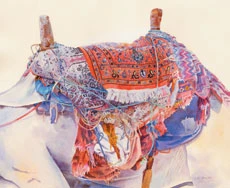
The expectations of Western European society require that people of a ‘certain age’ quietly disappear into non- productive obscurity, take up crochet and rot decently in an atmosphere of genteel decay with a bus-pass and endless reruns of soap operas. Not however the artist Dorothy Boyer. She is infinitely more likely to be up to her elbows in linseed oil and titanium powder or in a Jeddah souk hunched against a wall with a pencil and pad catching the atmosphere in a few deft stokes.
She once described herself both as loving contrast and drama and as a person of extremes — hating the bland and ordinary. To that one should add the mediocre and idleness, for Boyer emanates an air of endless energy yet a precision of purpose that characterizes her art. Just getting her in one place long enough to discuss her imminent first solo exhibition was like flagging down the TGV for a baguette from the bar.
“I don’t remember ever not having an interest in art,” she confided, cheerfully admitting that she is self-taught. Typically, that did not involve painting by numbers, but whole days in front of the works of Old Masters in Glasgow galleries and then endless hours working away on her own perfecting techniques which she had seen.
“So I did actually learn from the masters, believe me. I have no interest in flattery of the “oh isn’t that lovely” school. I am not like the masters yet. I am really critical of my own work.”
Boyer is of the much scorned ‘old school’; do it right or just do not start. She is, as she admitted, driven by a fear of failure and that makes her work “on the edge.” “My whole life is my work,” she said.
Boyer trained at the Inchbald School of Interior Design when she was a mature student, already having satisfied her family and qualified as a teacher given up the idea. Her natural talent plus phenomenal ability to concentrate on her work shutting out diversions led her to graduate as the top student. Following up her newly acquired skills she took courses in Faux painting or trompe l’oeil (literally “mistake of the eye”) — a technique of painting so realistic that the eye is fooled into thinking that a painting of an object is the real thing. Boyer’s talents quickly became apparent and her skill at trompe l’oeil painting landed her commissions with important houses and institutions in the UK.
Boyer mused over one particularly interesting commission. “I had to copy the pattern of the stone in a Sienna marble fireplace in Andrew Lloyd Webber’s house. The problem was that it was impossible to match the old stone with new as modern marble came from a different part of the quarry.” When finished, Boyer had achieved an exact match and further established herself as one of the best in an esoteric craft.
That abundant skill brought her to the Kingdom in 1995 to decorate the 26 large wall panels and the dome of the Laylaty Ballroom in Jeddah. There Boyer gave full rein to her creative skills in a feast of Baroque style painting; and in the cartouches surrounding the paintings, a masterclass in trompe l’oeil technique. Having completed that project, Boyer stayed on in the Kingdom and quickly became in demand as designer and painter of many villas of the Saudi business community in Jeddah.
Now much in demand among Saudi women for her classes in Faux and trompe l’oeil painting techniques, Boyer noted that her role as teacher is not one of a professional painter who couldn’t make the grade.
“I teach partly because I love the craft but also because it carries on the tradition of house decoration that exists among women in the Kingdom.” Mixing the paints and varnishes from raw materials and maintaining the brushes and equipment is part of the course. “It trains them to take pride in what they are doing; only that way do you get real perfection. You would be surprised at the sense of purpose that it gives the women to be able to do that,” said Boyer. “The original idea was that they learned and told the men how to do it — but it quickly became apparent that they wanted and were perfectly capable of doing it themselves.”
In 1980’s UK most of the professional home decorators — painters — were women; so opined Boyer the tradition and skills continue. “Painting is my first love — and teaching comes from that. It is very hard to do — it saps your energy. “
Boyer made a living by turning from painter to wall decorator — but now she has turned back to her first love, watercolor painting, which now occupies more than half her time.
“It’s really quite spiritual and requires tremendous concentration you cannot change a painting once it is done. You really have to reach a level — I pull my phones out and get really antisocial, go completely right-brain.” Watercolor painting, she said, completely transported her.
The title of her forthcoming exhibition at the Alamia Gallery in Jeddah is titled “Bridging Cultures.” What has a bowl of flowers or a painting of a selection of fruit to do with that, I wondered.
In a word: Light.
Boyer has become a familiar figure in the souks and alleys of Old Jeddah. She sits and sketches for three hours or so at a time, making line drawings and watercolors as visual notes and then creating the final painting from these.
“The local people are fascinated by me and over the years have got used to seeing me about the place.” The police sometimes ask what she is up to, but Boyer produces a permit and they courteously move on.
“The point is I paint the light wherever I go in my travels,” she said. “I accumulated a body of work that was based on that; I wanted to try to get this idea over.”
She first realized that painting — and in particular the quality of light — was a means of communicating across cultures at an exhibition. A Japanese woman was so moved by one of Boyer’s paintings that tears streamed down her face — and she said it spoke to her. “Then I realized that art really is a language in its own right, and that it does cross cultures.”
If the scene she paints has the light she is after, said Boyer, that is the key. The pursuit of light and its effect on people and things is the thing that crosses cultural boundaries. The paintings are not mementoes of Saudi Arabia said Boyer, only about light. “Watching light fall in the souk — powdery buildings and dust — I sit for hours trying to get that. If I don’t, I tear it up, you can’t change a watercolor.”
She reflected that she could not afford to be angry at herself when she did that; “it’s too destructive. I have to accept that painting is a journey. It’s not necessarily about the end.” She regards the failures simply as wrong turnings.
The forthcoming exhibition is not so much a themed journey but, as Boyer said modestly, more “a chunk of my work.”
“It’s about Saudi Arabia mainly because I am here,” she said. Her exhibition will consist mainly of watercolors — many of the dusty souk — and boats, another of Boyer’s favorite subjects.
“What it is really about is the experience of painting — not about what goes into the frame. That is a by-product. It is the experience of painting that is phenomenal — it’s like a drug, it’s a passion and completely addictive.”
Exhibition May 6 through May 13, 2007: Al-Alamia Gallery, Off Arafat Street, Nr. Chamella Plaza, Jeddah.