RIYADH, 4 May 2007 — Saudi Arabia helped to broker an agreement yesterday between Sudan and Chad aimed at reinforcing territorial integrity and rooting out opposition forces from both countries that are using the border region as a base of operations.
Sudanese President Omar Bashir and Chadian President Idriss Deby met at Custodian of the Two Holy Mosques King Abdullah’s Janadriya ranch north of the capital.
King Abdullah arrived at the ranch along with Bashir after he had received him yesterday afternoon at the Riyadh Airbase Airport. Moments later, Deby arrived in a separate motorcade. The king had a closed-door meeting with the two heads of state before the deal was signed.
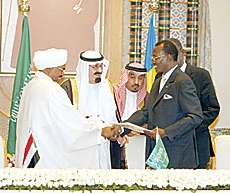
The audience attending the agreement included ministers of state from Sudan and Chad as well as Crown Prince Sultan and Riyadh Gov. Prince Salman, who applauded as both presidents embraced one another after signing the agreement. King Abdullah afterward embraced both leaders and wished them every success.
“The best of words are the simplest and most meaningful,” King Abdullah said after the signing. “May Allah bless them to serve their religion and countries.”
The king later bestowed the King Abdul Aziz Medallion, the highest civilian award given by Saudi Arabia, on both leaders. The agreement stressed that both countries should respect each other’s territorial integrity and refrain from interfering in each other’s affairs or shelter opposition forces of each party. It furthermore stressed that these forces should be ejected immediately from Sudan or Chad.
Chad has repeatedly accused Sudan of backing Chadian rebels and of supporting attacks in Chad by Janjaweed militia based in Sudan’s troubled Darfur region. The Sudanese government denies any ties to the militia. Last month the US and Britain threatened heightened sanctions against Sudan after the United Nations issued a 44-page report accusing Sudan of painting airplanes and helicopters to look like UN relief planes and then using them to attack villages in Darfur.
A spokesman for the president of Chad thanked the government of Saudi Arabia for inviting both heads of state to sign the reconciliation deal here. “It is an honor for both nations: Chad and Sudan,” said Mahamat Hissene, director of the Civil Cabinet of the Chad president. “We hope that the brotherly relations would return to what they were before and would be strengthened, especially since family relations are strong between the two countries.”
He said the fact that Custodian of the Two Holy Mosques King Abdullah had attended the signing of the reconciliation deal will put more responsibility on the presidents and both the countries to abide by the signed agreement.
“All of the points in the agreement are obligatory on both nations,” he said, adding that Chad and Sudan were committed to implement the points agreed on.
The official said that the Darfur issue had created tensions between both countries. He noted that the Chadian government had requested for civilian and not military troops to ensure the necessary erection of camps in Chad. “No agreement has been reached between the United Nations and Chad due to the presence of these troops which have the responsibility of erecting these camps,” he said.
On his part, Sudanese Minister of State for Foreign Affairs Ali Karti said that the reconciliation agreement aimed at fixing the relations between Chad and Sudan.
He noted that previous agreements such as the Tripoli agreement signed in 2006 was never implemented because it was flawed. “Today’s agreement is more comprehensive than previous agreements,” he said. He said he was optimistic that the agreement signed would be implemented since the Kingdom brokered it. The minister mentioned that the main point agreed upon was security of the borders. He also said that the disputes were mainly because tribes in need of water resources for their herd were crossing borders. “The agreement has stressed that both countries establish programs for the development of people living in rural areas.”
The minister denied that the Kingdom had given special guarantees to the government of Sudan to develop its country, adding that Saudi Arabia was a nation that helps all Muslim countries.
Political observers in the region also commended the Kingdom’s role in easing tensions in the Middle East and Africa.
Commenting on the delivery of wanted Sudanese suspect to the World Court, Karti said that Sudan would not deliver any wanted suspect to be tried outside of Sudan, even if he was an opposition member.
Corrigendum
JEDDAH — Tabuk Gov. Prince Fahd ibn Sultan’s office meanwhile, stated yesterday that the report on a Saudi-Egyptian causeway project to link two continents that appeared on Thursday, May 3, is not correct and there was no discussion on the feasibility of such a project.