
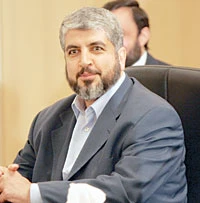
The best way for the US to secure its interests in the Middle East is to end its Israel-centric policies, said Khaled Meshaal, the chief of Hamas’ Political Bureau in an interview with the Arab News. Meshaal was on official visit to the OIC headquarters in Jeddah on March 22, 2007, where he had a successful meeting with OIC Secretary-General professor Ekmeleddin Ihsanoglu. Among other things, Meshaal spoke about the Makkah Agreement leading to the formation of a national unity government in Palestine and the OIC’s continued support for the Palestinian cause. Excerpts:
Q: What role should the OIC play vis-à-vis the Palestinian national unity government in the next phase?
A: The OIC has played an exceptional role in containing the internal crisis between the Hamas and Fatah and has contributed to the Palestinian reconciliation that took place in Makkah. Therefore, we look forward to a continued role by the organization vis-à-vis the unity government, and that is what has been discussed with Secretary-General professor Ekmeleddin Ihsanoglu.
In brief, the expected role involves, firstly, supporting the government financially. The organization can play the role of mediator by facilitating the transfer of funds to the unity government. Secondly, mobilizing the largest possible political and financial support for this government at both regional and international levels, as well as encouraging all countries to recognize the unity government while calling on the international community to lift the unjust blockade on the Palestinian people and their legitimate government. And thirdly, maintaining communication with the presidency of the Palestinian Authority and head of the Palestinian government as well as the different Palestinian factions to strengthen the Palestinian unity.
Q: How do you evaluate the role of the OIC in promoting the Palestinian cause?
A: Since the start, the role of the OIC has been well appreciated. At the same time, because of the present powerless and divided nature of the Ummah, we will not overburden either the Ummah or the OIC. Unfortunately, the 9/11 attacks have caused a degree of confusion between the concept of resistance and the concept of “terrorism”. The American administration has tried to accuse Muslims and Islam of terrorism, attempting to establish a linkage between this unjust description and Muslims’ legitimate struggle. So Arab and Muslim states need to regain a firm foothold and develop their own strategy to carry them forward.
With regard to helping the Palestinian people, Palestinians urgently need support for their resistance to and defiance of the Israeli occupation. They also urgently need all Muslims to stand by them in their legitimate efforts to achieve their right to an independent, sovereign state with Al-Quds as its capital. The Palestinian people also urgently need all kinds of support — financial, political, public, social, humanitarian and media support.
Q: How can the Arab and Muslim identity of Al-Quds be protected?
A: The increasing Israeli threats to Al-Quds and other Islamic and Christian holy places place added responsibilities on Arabs and Muslims to protect this Holy City and its identity. One urgent step is to help Jerusalemites to preserve the Islamic landmarks of the city.
Q: The Makkah Agreement ended inter-Palestinian fighting and succeeded in bridging the political gap between Hamas and Fatah. Will this create a common political ground to revive and strengthen the peace process?
A: Undeniably, the Makkah Agreement has been an important step in preserving and strengthening the internal Palestinian front. No doubt the agreed political program for the unity government will help achieve Palestinians’ national rights. There will be no security and no stability as long as occupation continues.
Q: How can the US seek to achieve security and stability in the Middle East region?
A: There is only one way for the US and that is to change its foreign policy, which is biased in favor of Israel. This requires recognizing and respecting the Palestinian right to self-determination and to an independent, sovereign state, and compelling Israel to end its occupation and its persistent violations of the Palestinian people’s human rights.
Q: The US accuses Hamas of terrorism.
A: Hamas has never targeted American or non-American interests. In fact, it has never conducted any military operations outside Palestine. Still the American administration accuses Hamas of terrorism and this is only because the US looks at this region from an Israeli perspective. In addition, the American policy is deliberately confusing the issues and puts itself in a position of hostility toward Islam and Muslims.
Q: Would you be against American interests in the Middle East once the Palestinian state is established in accordance with UN resolutions?
A: The US has the right to seek to further its interests, as long as that is not at the expense of our rights and interests.
Q: What is your message to the American people and the present and future American administrations?
A: The present administration has no desire to listen to any other side than the Israeli one. The next administration, if it wants, can correct this course of action. My message to the American people is that it is high time for them to start rescuing their interests and the status of the US on the international stage, which has been badly damaged because of the wrong policies and practices against the peoples of the world, especially in our region. The American people should recognize that Israel has become a burden on them and their interests and future. They have to realize that might alone can’t achieve security and stability and peace. Instead, justice and moral values are needed, and it is not enough to practice these values inside the country or community but to practice them with others outside it.
Q: What is your message to the West, especially Europe?
A: My message to Europe is that it is inappropriate for it to remain subordinate to American policies. Europe has a moral and paramount responsibility to restore a degree of balance to international policies.
We are a nation that loves peace; we are the nation of peace. We want to build our relationships with the peoples of the world, including the West and Europe, on the basis of civilized interaction and communication, mutual respect, reciprocal interests, and cooperation for the benefit of humanity and civilization — not on the basis of clashes and wars.