RIYADH, 9 May 2007 — The Gulf Cooperation Council (GCC) and the European Union (EU) are scheduled to meet in June this year to finalize the free-trade agreement between the two. The meeting will take place during Saudi Arabia’s presidency of the GCC and Germany’s presidency of the EU, GCC Secretary-General Abdul Rahman Al-Attiyah said here yesterday.
“We are in the final countdown,” he said. “The June meeting will most likely be the one that will wrap up discussions. Ministers have instructed officials to finish all matters that concern commodities and investment issues before the meeting.”
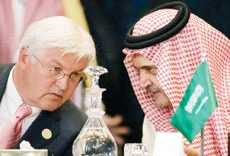
Speaking at a joint press conference held at the end of the 17th Joint GCC-EU Ministerial Meeting, German Foreign Minister Frank-Walter Steinmeier said that the EU wanted to ensure that the same benefits would be provided to European countries as exist between the GCC and other Asian countries or the United States.
“We want to ensure — and this is perfectly a normal international practice — that whenever a new free trade agreement is signed which offers better conditions, we benefit from those conditions,” he said. “That is something which still needs discussion though I think it is perfectly open to resolution.”
Saudi Foreign Minister Prince Saud Al-Faisal said that much had been done to resolve differences. Regarding the relaunched Middle East peace initiative, Prince Saud said that there had been signs of hope that Israel would accept the peace initiative during the German minister’s visit to Israel.
In answer to a local journalist’s question regarding when the EU would lift the “boycott on the Palestinian people”, the German minister said, “It is not fair to talk about an embargo on the part of the European Union. I would ask you to no longer use this term. The European Union has provided something like 20 percent more resources for Palestine than it has in the past years bearing in mind the deterioration in the situation for the Palestinian people. To call that a boycott is not something we can understand.”
He pointed out that the EU had contributed some 700 million euros last year and smaller amounts in previous years to the Palestinians.
Steinmeier said that he had met with five Palestinian ministers during his visit to the Palestinian territories. He said how things developed in the Palestinian territories would depend on whether the Palestinians were ready to accept the conditions of the international peace Quartet. The EU and GCC have confirmed in the final communiqué that they will not recognize any change to Israel’s pre-1967 borders other than those arrived at by agreement between parties.
The GCC and the EU welcomed the Arab peace initiative as reaffirmed in the declaration of the Arab League Summit on March 29 and supported it as an important opportunity to move the Middle East peace process forward.
The communiqué mentioned that the EU and GCC were looking forward to the meeting between the EU and the Arab League designated working group which will take place in Brussels on May 14. In addition to the free trade agreement, the EU and GCC seek to strengthen relations in the education, environmental and energy sectors. Initial progress on a GCC-EU free trade agreement was made in 1999 thanks to a deal among GCC states to lift tariffs within their own bloc.
In 2003 the Gulf countries agreed to a free trade pact and are forming a common market this year. By 2010 the GCC expects to have a common currency.
The European Commission expects trade volume to double soon after the agreement is signed.