
The Culture Wheel, is one of the most innovative performance spaces in the Arab world and also one of Cairo’s liveliest cultural hang-outs. Since its opening in 2003, this private cultural center has reinvented the concept of culture. One of the ‘Wheel’s’ greatest assets is undoubtedly the fact that it has made cultural events so accessible to people of all ages, nationalities and backgrounds. It has reinvented the concept of “popular culture.” The Sakia, as it is also known, welcomes people from all walks of life — young, old, children, foreigners and tourists.
The Culture Wheel is the brainchild of Mohamed El Sawy. Four years ago, he was looking for prime locations to install billboards for his Alamia Advertising Agency. During one of his prospective outings on the island of Gezira, in the residential district of Zamalek, he stumbled on a sad looking grey wall under the bridge leading to Mohandiseen. For many years this place of ill repute had been littered with garbage, until the government ordered it sealed off with a concrete wall. Intrigued by what might be inside, El Sawy ventured inside and immediately envisioned a stage with lights and curtains. He named this unusual cultural center in memory of his father, the late Abdel Moneim El Sawy.
A former minister of culture under the late Anwar Sadat, Abdel Moneim El Sawy, was very proud of his writing; he was both a novelist and a journalist. His most well known work is a five volume novel “El Sakia” (The Waterwheel). At the time of his death, he had finished four volumes: The Victim, Departure, Destiny, Repentance but was still working on the last, Reckoning.
“My father sought in his life to be of use to people, haring with them whatever knowledge and wisdom God bestowed upon him. After his departure we became determined that what he had offered in his life should not be stopped. So his waterwheel, the “Sakia” started turning again to quench the people’s thirst for knowledge and culture “ explains Mohamed El Sawy.
The wide-ranging cultural center includes the Earth Hall, the Wisdom Hall that can accommodate up to 600 for music and theatrical performances, the Word Hall, the Garden and the River Hall, a 400 seat amphitheater between the river promenade and the Nile. The Sakia also offers a general library, a children’s library, an electronic library, and a music library. It has a cinema club, hosts art exhibitions, seminars, lectures, workshops, poetry recitals and concerts. It is presently the best place in Egypt to listen to contemporary as well as classical music.
At a recent event, Mohamed El Sawy told the audience about one of the Sakia’s most important mission’s: To introduce talented artists: “Three years ago, when we staged Wust El Balad first concert, hardly anyone showed up. But gradually, by word of mouth, more spectators came and today hundreds of people show up and in fact we can not accommodate everybody. Wust El Balad is now one of Egypt’s most successful bands.”
The Cultural Wheel hosts about fifty events a month. It has opened its doors to people who do not ordinarily attend cultural events. One of its aims is to attract a broader cross-section of society and not only seasoned opera aficionados. Mohamed El Sawy is also eager to attract young people who will be regular visitors for many years to come. For them he has set up a Youth Program offering classes in painting, sculpture, piano and violin for children aged 6 to 14 for a nominal fee of less than SR25 a month. The price of the concert and theater performances are also kept to a minimum and never exceed SR20. Tickets to most performances are only SR7! And Sakia members with a special discount pay even less. Many events are also free. This low price policy has been one of the reasons for Sakia’s popularity. The other is due to the high quality of national and international artists. Well known musicians, writers and poets have performed in front of an enthusiastic public. Even the Brazilian Paulo Coelho, one of the world’s best-selling novelists, came to meet his readers at the Culture Wheel.
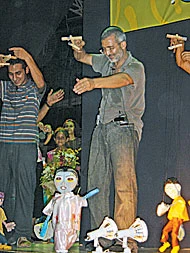
The Sakia is also reviving the ancient art of puppetry, which happens to be one of Mohamed El Sawy favorite pastimes. He wrote two puppet plays, one of them, “Om Kolthoum Back on Stage” is performed with a background of the singer’s greatest songs.
The team that masterminds the cultural events is particularly creative. To encourage other youths to follow their example, the Culture Wheel has set up the Sakia Cultural Management Academy which offers courses in cultural management.
The success of the Cultural Wheel has far exceeded initial expectations. An example to be emulated in the Arab world, it not only offers culture at its best but it is also “a site that is intent on protecting freedom of thought and the freedom of its visitors to enjoy culture,” concludes Mohamed El Sawy.