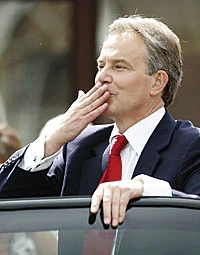
LONDON — In one of the longest goodbyes in British political history, Tony Blair yesterday finally announced his intention to resign as leader of the ruling Labour Party and as such prime minister of the UK on June 27.
On that day, Tony Blair will make the short journey from No.10 Downing Street to Buckingham Palace for the last time to formally hand in his resignation to Queen Elizabeth, paving the way for his successor, most likely Chancellor of the Exchequer Gordon Brown, to take over as prime minister.
Blair’s announcement came yesterday morning in an emotional yet tempered speech to party activists in his Sedgefield constituency in the Northeast of England. The Prime Minister was given a standing ovation by some 300 Labour activists and members who had crammed into the tiny Trimdon Labour Club to hear him speak, waving placards declaring “Sedgefield Loves Tony,” “10 Great Years,” “Thank You” and “Britain is Better.”
In a largely impromptu but poignant speech, Blair declared to his loyal supporters and to the country and world at large that “on the 27th of June, I will tender my resignation from the office of prime minister, to the queen. Sometimes the only way you conquer the pull of power is to set it down. There are obviously judgments to be made on my premiership and in the end that is for you the people to make. I came into office with high hopes for Britain’s future, and I leave it with even higher hopes for Britain’s future.”
He thanked the British people “for the times that I have succeeded” and apologized “for the times I have fallen short.” He stressed that it has been an honor to serve the British nation.
“This country,” he added, “is a blessed nation. The British are special. The world knows it, in our innermost thoughts, we know it. This is the greatest nation on earth.
“Britain is not a follower today, Britain is a leader…It is a country comfortable in the 21st Century, at home in its own skin, able not just to be proud of its past but also confident in its future.”
In response, opposition Conservative Party leader David Cameron warned that the country faces seven weeks of “paralysis” and a lame-duck administration, until the Labour Party chooses a new leader. He accused Tony Blair of running a government of the “living dead.”
Earlier, the prime minister had briefed his Cabinet on his plans, with his chancellor, according to several Cabinet colleagues, paying “handsome tribute” to Blair praising “his unique achievement over 10 years and the unique leadership he had given to the party, Britain and the world.” It will be government business as usual for Blair until June 27, by which time the Labour Party would have elected a new leader. The timing also coincides with the EU and G-8 summits in June, which would be Blair’s swansongs on the international stage.
The party leadership election process will now start in earnest. Though Gordon Brown is widely regarded as the man to succeed Blair, he will probably face a challenge “in the interest of party democracy” from one of two left-wing backbenchers — John McDonnell and Michael Meacher, the former environment secretary. The pair met late yesterday to discuss if one of them should step down so that the other could get enough signatures from fellow members of Parliament to get his name on the ballot paper. Under Labour Party rules, candidates need the signatures of 45 Labour MPs to enter a leadership contest.
At the same time, shortly after Blair’s announcement, Deputy Prime Minister and deputy leader of the Labour Party, John Prescott, also announced his intention to stand down, precipitating a similar contest for the deputy leadership. Here though there are far more candidates including Peter Hain, the Northern Ireland secretary; Harriet Harman, the solicitor general; and Hazel Blears, the Labour Party chairman.
Over the next few weeks, political pundits will no doubt discuss, analyze and scrutinize the Blair years ad nauseam. Perhaps it is too early to talk about the Blair legacy, but one commentator yesterday perhaps described it most aptly when he asked: “How come it is the same man who gave us the Northern Ireland peace settlement, and the invasion and war in Iraq?”
Blair admitted that expectations had probably been “too high” in 1997, but he insisted living standards had improved under Labour.
“There is only one government since 1945 that can say all of the following: more jobs, fewer unemployed, better health and education results, lower crime and economic growth in every quarter. Only one government, this one,” he robustly declared.
On foreign policy, the prime minister acknowledged the terrorist “blow back” from the “bitterly controversial” invasion of Iraq and Afghanistan and he urged Britain to stay the course in the fight against terror. “I decided we should stand shoulder to shoulder with our oldest ally, and I did so out of belief. For many it simply isn’t and can’t be worth it. For me, I think we must see it through. They, the terrorists who threaten us here and around the world, will never give up if we give up. It is a test of will and of belief and we can’t fail it.”
Predictably, the White House praised Blair as “an extraordinary leader” and a friend and ally of US President George W. Bush.
“Also the prime minister has demonstrated the ability to work with presidents of both parties and to maintain a long tradition of an alliance that is of extraordinary strategic importance,” White House spokesman Tony Snow told reporters in Washington.
“We certainly appreciate everything he has done, but furthermore the fact that he plans to have a very active schedule” until his departure, Snow added.