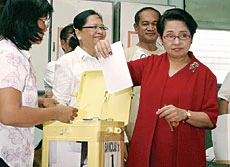
MANILA, 15 May 2007 — At least 13 people were killed yesterday as Filipinos voted in midterm elections considered “relatively peaceful” by police despite widespread violence, fraud and irregularities.
“We have noted a relatively peaceful situation nationwide, and I am confident that this will be the ultimate outcome until after the entire election process is completed,” national police Director General Oscar Calderon said hours after voting ended at 3 p.m.
Calderon said there were some pockets of violence, but claimed they weren’t bad enough to dampen the spirits of the electorate.
Yesterday’s fatalities raised the number of election-related killings since January, the start of the political campaign, to 127, including 61 politicians and candidates. More than 130 people were wounded, police said.
The figure was still way below compared to the 2004 election that left 189 dead.
But watchdogs and media lamented that the election situation has not improved despite a massive information campaign by the government and civic groups against fraud.
“It was a picture of chaos,” said Joe Dizon, a Roman Catholic priest from the election watchdog Kontra Daya, or “Against Cheating.” “There was confusion in many areas,” he added.
Filipinos were electing 12 out of 24 senators, all 236 House of Representatives members, party-list groups, and nearly 17,500 governors, mayors and other local officials.
Election officials projected turnout at a whopping 75 percent of the 45 million registered voters as people took advantage of the day off, sunny skies and tight security.
Scattered reports of vote-buying and other cheating incidents trickled in. Balloting was postponed in several districts, particularly in the southern region of Mindanao, the Southeast Asian nation’s Muslim homeland.
On election day, a village chief and a candidate for town councilor in the northern province of Abra were killed in separate attacks, while two supporters of the incumbent governor in the central province of Masbate were also gunned down in Pio Cruz town. In nearby Milagros town in Masbate, a brother of the incumbent vice mayor was gunned down by unidentified attackers, while two poll watchers were killed when gunmen aboard a helicopter opened fire at their boat in the village of Sawmill.
One was also wounded, while eight others were missing in the attack in Sawmill, according to an initial military report.
Six more people were killed in separate shooting incidents in the country, including shootouts between supporters of rival candidates in the southern provinces of Basilan and Lanao del Sur.
There were also incidents in which gunmen opened fire at civilians in a bid to stop them from casting their votes, police said.
A school where voting was scheduled to take place was also burned down in Basilan. Numerous complaints of hitches and polling irregularities — including missing names on voters’ lists, alleged vote-buying and voter harassment — were also reported throughout the country.
Vote-buying and cheating are practiced in some parts of the Philippines, where rival clans slug it out for lucrative public positions, but analysts said they were concerned attempts to manipulate results could be more widespread in this poll.
Failure of Election
Elections were not held in 17 precincts in Biñan, Laguna, 10 towns in Lanao Del Sur, six precincts in Basilan, one precinct in Lanao Del Norte, one town in Datu Shariff Kabunsuan, and two villages in Zamboanga Del Norte, the Comelec said.
In the Mindanao provinces, threats of violence have kept public school teachers from forming themselves into boards of election inspectors. In Biñan, the teachers did not want to report for duty because they were not registered voters in that area, the Comelec said.
Election Commissioner Rene Sarmiento said no elections were held in these Lanao Del Sur towns because of reported firefights that still have to be verified: Bayang, Lumbatan, Madalum, Binidayan, Puales, Sultan Dumalondong, Lumba-Bayabao, Masiu, Kapai, and Lumbayanague.
In three precincts each in two barangays in Basilan, the BEIs did not serve because of “security reasons.” Elections in barangay Cayontor, Kuaswagan, Lanao Del Norte did not push through because “20 fully armed men” fired at the school teachers who were on their way to the polling area.
In Zamboanga Del Norte, two villages did not hold elections because of reported Abu Sayyaf activity. “Despite the augmentation of AFP (Armed Forces of the Philippines), the BEIs were afraid to report for work,” said Sarmiento.
Elections had also been postponed in the town of Barira in the province of Datu Shariff Kabunsuan, after the mayor, Alex Tomawis, refused to turn over election paraphernalia to the BEIs.
In some areas, voting was delayed after election materials, such as ballots and ballot boxes, were delivered late because of security concerns and political tensions, Commission on Election Chairman Benjamin Abalos said.
Amid the chaos, President Gloria Macapagal Arroyo appealed for calm and understanding.
“There are intense fights in all campaigns, but let us be gracious, win or lose,” she said in a statement.
“For the sake of the nation, we should put a closure to all chapters of conflict and battles once the nation makes its decision, and open all doors to national reconciliation and unity.”
Refendum on Arroyo
The race largely was seen as a proxy war between Arroyo, a daughter of the political elite, and her predecessor, Joseph Estrada, who was forced from office in January 2001 in the country’s second “people power” revolt and is on trial for corruption allegations.
It has also been billed as a referendum on Arroyo, who has faced various controversies in the past two years, including allegations that she rigged the 2004 presidential vote.
Counting is by hand, so official results are weeks away, but opinion polls showed the opposition certain to hold onto control of the Senate, where the top 12 vote-getters nationwide will win seats.
Early figures compiled separately by ABS-CBN television and AMA Computer School showed only two pro-Arroyo candidates in the top 12, which also included two former military officers who are fighting charges of involvement in coup plots and the son of former President Corazon Aquino.
The House of Representatives, however, was likely to remain in the hands of Arroyo’s backers, which would doom any effort to launch a third impeachment bid against her over allegations that she fixed the 2004 election.
Joel Rocamora, a research fellow of the Institute of Popular Democracy, noted that because yesterday’s vote was the first to be held since Arroyo was accused of cheating in 2004, the results would determine the public’s real sentiment about her government.
“The legitimacy of this government will be decided in these elections,” he said. “That’s why there are many foreign observers who want to know if there will be credibility in the current elections.”
“The Philippines needs change, we are No. 1 in Asia in corruption,” said bus driver Efren Santos, 58. “I voted for people who can change this country because it is becoming poorer.”
Arroyo’s six years in power have been a mixed bag of steadying the economy while lurching from crisis to crisis, including at least two coup plots, terrorist attacks and a string of natural disasters.
But while Arroyo’s approval ratings are low, general disenchantment among the poor majority has been offset by the stock market rising 12 percent this year and the peso hitting its strongest level against the US dollar since October 2000. (With input from Agencies)