
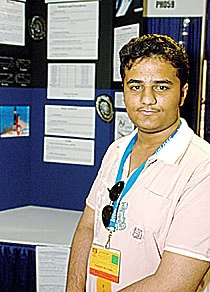
ALBUQUERQUE, New Mexico, 18 May 2007 — They say if you want the sun, moon and the stars you should get a good education, but for Yazeed Al-Turki of Riyadh’s King Faisal School, he’s aiming a little bit higher than that.
Al-Turki, one of the Saudi finalists at the International Science and Engineering Fair being held this week in Albuquerque, is going beyond the stars into the realm of black holes and event horizons as he explores the ends of the universe with astrophysics.
Scientists believe that black holes are created when stars collapse into compacted items so dense with such intense gravitational fields that even light cannot escape from them. No one has ever seen a black hole, but their existence has been considered for decades. In fact, among the only possible indicators of a black hole are massive bursts of X-ray energy when matter essentially implodes as it is sucked ever closer to the super-dense object. The event horizon essentially is the boundary around a black hole from which there is no escape for anything matter or even light.
It’s pretty impressive when a teen-ager can actually grasp such a concept, and it’s even more impressive when a teen-ager can contribute research on the topic. His science fair entry is titled “Type 1 X-ray Bursts and Fast Flares.” So the obvious question is: How does a kid from Riyadh get involved with astrophysics?
“I had a general interest in it before, so I applied for a summer program at Massachusetts Institute of Technology,” Al-Turki told Arab News. “When I went there I worked with a mentor, Dr. Ronald Remillard, who had access to the Rossi X-Ray Timing Explorer, which is a satellite monitored by NASA.”
The satellite records bursts of X-ray radiation, the same type of energy used to look through the human body at hospitals except on an almost unimaginable scale. Al-Turki was asked to help correlate the satellite data.
“Dr. Remillard assigned me to the catalog of the satellite, and then I started looking at the bursts in order to organize them in the first place,” he said. “They were not organized, and the sources were not known, so I developed a method to differentiate the sources.”
That’s when the young Saudi began to see a pattern.
“When I organized the sources, I noticed that Type 1 X-ray bursts were only coming from neutron stars, and I used that to deduce a method to prove the existence of event horizons.”
He said that getting excited about something as abstract as theoretical physics comes from within.
“I had some teachers at school who were interested, but mostly it was personal curiosity and reading because theoretical physics has no physical application, so you can’t be motivated by looking at the world,” Al-Turki said.
He does credit his father, a former Saudi Aramco engineer who now runs his own business, and his mother, who was a biology teacher, for encouraging him to think.
“My parents have always been behind me,” he said. “They both specialized in scientific fields so they were always supportive of me.”
Al-Turki already is setting his college goals.
“I’m planning to go to University of Chicago where I hope to major in astronomy and physics. I want to do a double major in economics, which is another interest of mine,” he said. “I want to go on for a master’s degree in science, probably in physics.”
As for his career goals, he says they may be a little more down to Earth.
“I may work in business and do my research on the side,” Al-Turki said. There are many chances out there, and I’m flexible about it. Research will always be there, no matter what career I choose to pursue.”