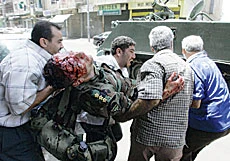
TRIPOLI, Lebanon, 21 May 2007 — Lebanese tanks pounded shells at a militant group’s headquarters in a Palestinian refugee camp next to the northern city of Tripoli yesterday in clashes that left 13 soldiers and 17 militants dead and wounded dozens.
Security officials also said 19 soldiers and 14 police officers were injured in the fighting, the worst violence to hit the northern city in two decades. Hundreds of Lebanese citizens could be seen applauding the army as it shot into the refugee camp.
Ten militants were killed in a building in Tripoli and seven in the refugee camp, the security officials said.
A spokesman for the Fatah Islam group, Abu Salim, only confirmed that two militants were killed and five wounded inside the Nahr El-Bared Palestinian refugee camp. “Many houses have been destroyed,” he told The Associated Press by telephone from inside the camp.
A senior security official said a high-ranking member of the Fatah Islam group, known as Abu Yazan, was among those killed. Security officials spoke on condition of anonymity because of the sensitivity of the issue.
Abu Salim said he had no information on the report and denied the authenticity of a statement sent by fax to some news agencies that claimed the group would unleash massive violence if the army’s attack did not stop.
Residents in the Nahr El-Bared camp said at least 12 civilians were killed or wounded, but that figure could not be confirmed by Lebanese authorities, who have no presence there.
Syria said it had temporarily closed two border crossings with northern Lebanon “to preserve the security of Syrian and Lebanese inhabitants,” because of safety concerns over the clashes.
The violence adds one more destabilizing factor to conflict-ridden Lebanon, in the midst of its worst political crisis between the Western-backed government and pro-Syrian opposition since the end of the 1975-90 Lebanese civil war. It underlines the difficulties facing authorities in dealing with pockets of insecurity across the country that are haven for militants and troublemakers.
Prime Minister Fouad Siniora said the fighting was a “dangerous attempt at hitting Lebanese security” and called on the Lebanese to rally behind the government.
The clash between army troops surrounding the Palestinian refugee camp and Fatah Islam fighters began after a gunbattle raged in a neighborhood of nearby Tripoli, witnesses said.
The militant group is an offshoot of the pro-Syrian Fatah Uprising, which broke from the mainstream Palestinian Fatah movement in the early 1980s and has headquarters in Syria. As many other small factions in Lebanon, Fatah Islam’s allegiance is sometimes questionable in this deeply polarized country.
Some Lebanese security officials consider that Fatah Islam is now a radical Sunni Muslim group with ties to Al-Qaeda, or at least Al-Qaeda style militancy and doctrine. But some anti-Syrian government officials say they are a front for Syrian military intelligence aimed at destabilizing Lebanon.
Syria has been fighting its own Sunni militancy, and has frequently battled with radicals striking in Damascus neighborhoods.
The group is allegedly led by Shaker Youssef Al-Absi, a Palestinian living in Syria who was sentenced to death in absentia in July 2004 by a Jordanian military court. Al-Absi was found guilty of involvement in a plot that led to the assassination in Jordan of US diplomat Laurence Foley, an act that was blamed on Al-Qaeda in Iraq.
Major Palestinian factions have dissociated themselves from Fatah Islam.
The clashes in the camp began early in the morning shortly after police raided a militant-occupied apartment on Mitein Street, a major thoroughfare in Tripoli. Authorities said police were looking for suspects in a bank robbery a day earlier in Amyoun, a town southeast of Tripoli, in which gunmen made off with $125,000 in cash.
The armed militants resisted arrest and a gunbattle ensued. It spread to surrounding streets and continued through the afternoon.
Witnesses said the militants then seized Lebanese Army positions at the entrance to the refugee camp, capturing two armored carriers. The gunmen also opened fire on roads leading to the city and ambushed a military unit, killing two soldiers, security officials said.
Smoke billowed from the camp as a steady barrage of artillery and heavy machine-gun fire from army positions pounded militant positions inside the refugee camp.
By midmorning, the army had brought reinforcements and was firing on Fatah Islam positions.
“We strongly back the Lebanese Army troops and what they are doing,” said Abed Attar, a resident of Tripoli who stood watching army soldiers firing tank shells into the camp while others cheered. There have been longstanding tension between some Lebanese citizens and the tens of thousands of Palestinians who took refuge from fighting in Israel over the decades.
The dozen Palestinian refugee camps scattered in Lebanon are off limits to authorities, and some are controlled by armed fighters. Lebanese troops usually cordon the camps with checkpoints. Their presence around Nahr El-Bared increased in recent months after the tiny Fatah Islam group stepped up its actions.
The clashes evoked concern both at home and abroad for the stability of a country already in the grips of a six-month-old political crisis.
Lebanon’s feuding leaders showed rare unanimity in appealing for public support for the security services in their efforts to take on the Palestinian fighters.
Russia led the chorus of concern from foreign governments. “Such an upsurge of violence in an already tense situation in Lebanon gives rise to deep anxiety,” a Russian Foreign Ministry statement said. “These tragic events underline the need for respect by all parties of Lebanon’s sovereignty, territorial integrity, unity and political independence.”
The six-member Gulf Cooperation Council condemned clashes that “only destabilize fraternal Lebanon.” Its secretary-general, Abdulrahman Al-Attiyah, called on all groups present on Lebanese soil to “maintain its territorial integrity, sovereignty and stability,” in a statement carried by the official Saudi Press Agency.
Lebanese President Emile Lahoud and Prime Minister Siniora, whose supporters have refused to recognize each other’s authority for months, issued calls for support for the security forces.
Lahoud, an ally of neighboring Syria, called on the “judicial authorities to interrogate those militants in custody to determine who is behind their actions and what is the goal of their attacks.” He urged the public to “cooperate with the judiciary and the security forces to restore calm.”
Siniora called on the people of Lebanon to “join ranks behind the army and Lebanese security forces.” “The blows dealt by Fatah El-Islam against the Lebanese Army are a premeditated crime and a dangerous attempt to destabilize (Lebanon),” he said.
Parliament Speaker Nabih Berri, a pro-Syrian politician who has refused to convene MPs since last November thus paralyzing Siniora’s legislative program, also issued a statement condemning the violence.