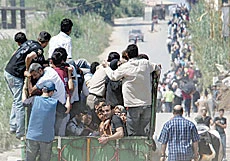
NAHR Al-BARED, Lebanon, 24 May 2007 — By foot or in overladen pickup trucks, thousands of refugees fled a battered Palestinian camp in northern Lebanon yesterday as the guns fell silent after three days of ferocious fighting between militiamen and the Lebanese Army.
But the embattled government of Prime Minister Fouad Siniora warned the militants and said its goal was still to “eliminate the Fatah Al-Islam phenomenon” after the bloodiest internal fighting in Lebanon since the 1975-1990 war.
Inside Nahr Al-Bared, the squalid camp pounded by three days of army shelling aimed at wiping out Fatah Al-Islam fighters, the streets were littered with rubble, the hulks of burned out cars, its buildings pockmarked with bullet holes and shrapnel.
The International Committee of the Red Cross estimated that between 13,000 and 15,000 refugees have poured out since the fighting halted on Tuesday. But nobody is being allowed in, sparking fears among some that the army may be preparing to resume its bombardment.
“Despite the deep wounds, the army remains...the guarantor of the united national will and will not be lenient with the gangs of terrorists,” the army command said.
The Al-Qaeda inspired Sunni militia said it would abide by a cease-fire it declared on Tuesday but was ready to take up arms again.
“We respect the truce, but we will not surrender. If we are attacked, we will fight until the last drop of blood,” spokesman Abu Salim told AFP.
The raging gunbattles around the camp and in the neighboring Mediterranean city of Tripoli killed 68 people, including 30 troops, 19 Palestinian refugees, 18 militants and one Lebanese civilian.
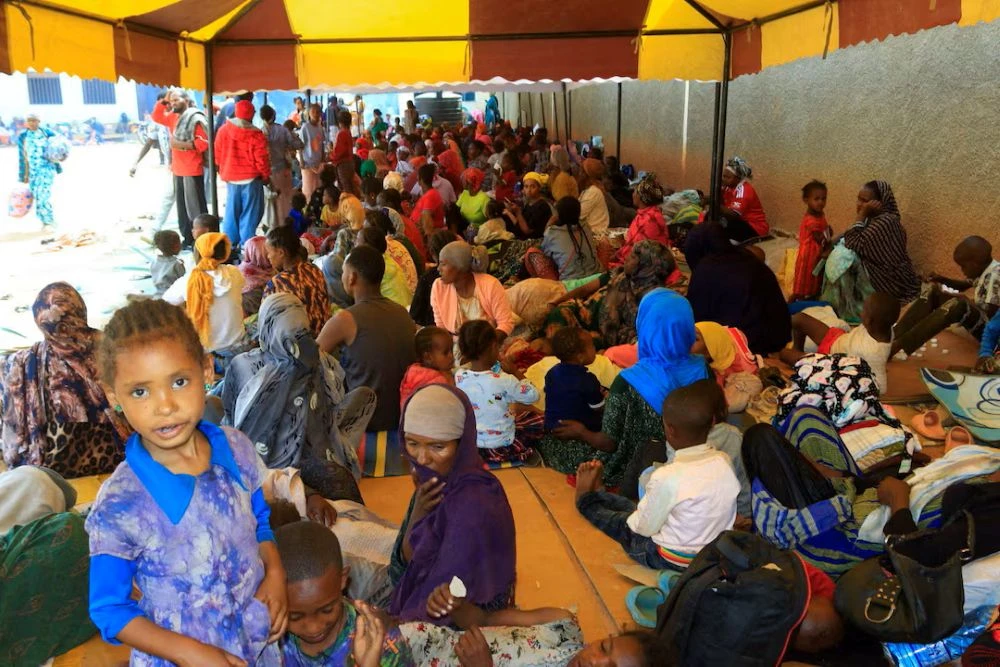
Relief agencies voiced continuing concern about the refugees’ plight as men, women and children poured out of Nahr Al-Bared toward the nearby Beddawi refugee camp or Tripoli, Lebanon’s second largest city.
“Just like the exodus from Palestine in 1948, we fled on foot, with a bundle of clothes on our heads. Back then, we were welcomed by the Lebanese, today we are seeking refuge with other Palestinian refugees,” said Faiza Rashrash, sitting on a thin mattress on the floor of a school in Beddawi.
Aid agencies and volunteers are battling to provide help for the displaced, who recounted scenes of disaster in Nahr Al-Bared where people were without food or water or electricity.
“We are providing relief aid to the thousands of refugees who have sought refuge in our schools and centers in Beddawi and Tripoli,” said Hoda Samra, spokeswoman for UN Palestinian refugee agency UNRWA.
“Our clinics are also working double shifts in order to cope with the number of refugees and provide them proper services.” The fighting had stoked fears it could spread to other Palestinian camps and further shake the security of a country riven by sectarian and political tensions.
Tuesday’s aid efforts were hampered when two Palestinian civilians were shot dead after aid trucks moved into the besieged camp, according to a UN official.
Sultan Abul Aynayn, the head of the Palestinian mainstream Fatah movement in Lebanon, issued an urgent appeal for humanitarian organizations to help, saying the displaced refugees were “totally destitute.”
The emergence of Fatah Al-Islam has underscored the fragile security situation in Lebanon, where Western-backed Siniora government is grappling with a months-old political crisis and a string of attacks against critics of former power broker Syria.
The United States, which provided $40 million in military aid to Lebanon last year and $5 million so far in 2007, said it was considering providing extra military aid.
“The Siniora government is fighting against a very tough extremist foe,” US Secretary of State Condoleezza Rice said. “But Lebanon is doing the right thing to try to protect its population, to assert its sovereignty and so we are very supportive of the Siniora government and what it is trying to do.”