
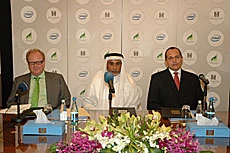
JEDDAH, 24 May 2007 — Intel’s new generation of Ultra Mobile Personal Computers (UMPC) are expected to become a unifying factor for knowledge workers at Knowledge Economic City Madinah.
The global IT corporation signed a memorandum of understanding yesterday to provide its best technology to Knowledge Economic City (KEC), which will include UMPCs — small personal computers the size of a mobile phone/PDA.
Intel Corporation is the world’s largest semiconductor company, with a market capitalization of nearly $120 billion and annual revenues of more than $35 billion. Headquartered in Santa Clara, California, Intel was formed in 1968 and has 94,000 employees worldwide.
Signing on Intel Corporation’s behalf, General Manager for Saudi Arabia Ferhad Patel said Knowledge Economic City was rapidly developing as a center of excellence for ICT development in the Middle East and Intel was keen to be part of it.
“We recognize the opportunities that the youthful demographics of MENA as a whole provide and the potential for Knowledge Economic City as a Smart City.”
KEC Chief Executive Officer Tahir Bawazir, signing on behalf of KEC, said the Intel MOU would result in accelerated access to technology for everyone, which was a key factor in keeping Knowledge Economic City out in front.
“KEC’s collaboration with Intel, Cisco, CompTIA and other key international IT innovators with whom we are formalizing relationships will ensure that we achieve our objective of becoming a world leader in the ICT arena.”
Access to the latest in computing hardware is of major importance to KEC’s Chief Technology Officer Mohammed Shah who has the responsibility for developing the infrastructure needed to provide seamless connectivity for KEC’s workers and residents. “Our knowledge workers will be encouraged to use Intel’s UMPCs as a single source for all of their applications in our connected smart city, instead of having a pocket full of devices for different applications,” he said.
The Intel agreement was the first of two memoranda of understanding signed yesterday.
The second was with The Competitiveness Institute (TCI), a global authority on competitive economics and cluster development.
“Dr Lars Eklund said TCI’s mission was to improve living standards and the local competitiveness of regions throughout the world by fostering cluster-based development initiatives. Knowledge Economic City was an excellent example of this type of initiative and the perfect place for the Institute to establish a regional headquarters,” he said.
Knowledge Economic City Madinah is the one of six economic cities being developed in regional areas of the Kingdom of Saudi Arabia to create employment and drive economic development outside of the major cities of Riyadh and Jeddah.
The SR25 billion ($7 billion) project is located at Madinah.
KEC Marketing Director Mohammed Khoja said Knowledge Economic City is designed as a project that will position Saudi Arabia and young Saudi Arabian entrepreneurs as internationally respected leaders in knowledge-based industries and aims to attract and develop talent from around the world.
“It will provide them with opportunities on a global scale while providing investors and entrepreneurs with infrastructure, opportunity, a unique pool of talent and the potential for a healthy return on investment,” he said.
More than 20,000 jobs and accommodation for about 150,000 people will be created by the project which is expected to bring about SR10 billion a year into the region once it is completed by 2020.