
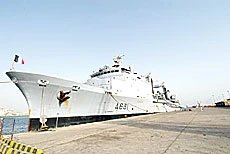
JEDDAH, 27 May 2007 — The French Durance class command tanker “Somme” with the current commander of Task Force 150 (CTF150) Rear Adm. Alain Hinden was on a visit to Jeddah last week.
The visit was part of the ongoing “Operation Enduring Freedom” established after 9/11. The aims of the visit were to liaise with and maintain the cordial relationships between the Kingdom and France and to develop compatibility between the communications and technical aspects of naval infrastructure.
“Also, ships have to stop — even supply ships — and the crew rest and to liaise with neighboring countries,” said Hinden. “This is their region, so we have to work together and discuss the situation.”
Hinden’s area of command, which rotates through the coalition, covers an area that covers 2.4 million square nautical miles along 6,500 nautical miles of coastline from Kenya and the Seychelles, across the coastal nations of the Red and Arabian Seas to Pakistan. It does not extend inside the Arabian Gulf, an area covered by two other task forces — 158 in the north and 152 that covers the south.
He took command of the task force in Bahrain on April 4 succeeding UK Commodore Bruce Williams. Hinden said at the handover that the identical color of coalition flags, the uniforms and the identical strength of its will disguised the fact that the coalition consisted of different navies.
“What Task Force 150 does is serious and has to be done by working together. Our primary purpose is simply to help our friends,” he said.
The coalition task forces are unique in the world, Hinden believed, by being confined to this region. “Our mission is to prevent terrorists from using the sea for their benefit,” he said adding that it closed off the possibilities of travel and attack by seas as an alternative to land.
Pirates off the coast of Somalia hijacked a United Nations-chartered ship in late February with its 12-member crew shortly after it unloaded 1,800 metric tons of food aid and equipment — the fourth such attack on UN supply vessels off the East African country in 20 months.
“We have to cool down the illegal activities,” he said. “In the last 50 days we have seen 10 pirate attacks. There is an increase right now.” He added that the piracy attacks by small boats were very difficult to prevent because, “right before they are pirates, the men are fishermen.”
Hinden said that pirates usually used small fast boats to raid cargo ships. Raiders were not necessarily interested in the cargo, but in holding the ship to ransom for cash after forcing it into territorial waters. Though small, the boats were often heavily armed enough to become a serious threat to an unarmed cargo vessel.
He pointed out the continuous cooperation with Saudi Arabia both on a bilateral basis — between individual member countries and the Kingdom — and on a wider basis, between the coalition and the Kingdom. This, he said, was currently under discussion.
The 19 countries presently contributing to CTF-150 include Canada, France, Germany, Pakistan, United Kingdom, Japan and the United States. Other nations who have participated include Australia, Italy, The Netherlands, New Zealand, Portugal, Spain and Turkey. “We would like to add more and be pleased if all these coastal countries were in the coalition,” Hinden said adding that his command would be handed over to the Pakistan Navy on Aug. 2 in Bahrain.
Hinden said that the mission of CT50 had not changed since it was incepted about six years ago. “The fight against terrorism is still the main mission, but the way we do it is probably slightly different,” he said. He explained that over the duration of the mission, the coalition had gathered a great deal of information about local fishing areas, the movement of traffic and patterns of behavior of craft of all sizes in the area. “We are now in a position to use the information that we have gathered and so we are more efficient.”
Breaks in patterns or unusual movements — for example a dhow that pretends to be fishing — raises a profile and triggers investigation by a coalition ship.
The main areas of interest for the task force, said Hinden, were the coast off Somalia, the Gulf of Aden and the Arabian Sea. He pointed out that his area of responsibility was the high seas outside sovereign nations 12 nautical mile limit where control was the responsibility of those countries adding that it was of great benefit to have good relations with those countries as “hot pursuit” was not allowed. The exchange of information about suspicious ship movements however was very useful. “This is one of the reasons behind port calls,” he said.
The French fleet regularly carry out exercises with the Royal Saudi Navy — Hinden gave examples of recent operations involving carriers, search and boarding-at-sea training. “It is very useful if we all use the same procedures; it enables us all to work together under the same flag,” he said.
Hinden gauged success of the coalition activities by the figures on piracy and suppression of potential terrorist activities at the end of the year. “If they are down, it is a success,” he said — truly a case of less is more.