WASHINGTON, 27 May 2007 — It has long been known that President George Bush and Vice President Richard Cheney only make public appearances before audiences that have been pre-screened for being pro-Bush administration.
Now such pre-screening may need to be applied to Bush administration staffers before they wander out for public appearances.
Such foresight would have been useful for former Bush chief of staff Andrew Card, who got an earful on Friday when he accepted an honorary degree at the University of Massachusetts.
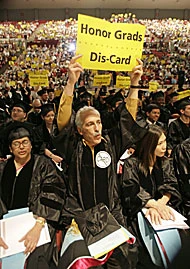
Card was jeered and booed by hundreds of students — including some faculty members who stood on stage with Card.
The 3-to-4 minute outburst drowned out Provost Charlena Seymour’s remarks as she awarded Card an honorary doctorate in public service. The protesters said they blame Card for his part in supporting the Iraq war, and said he lied to the American people in the early days of the war.
One faculty member onstage held a sign that read “Card — No honor, No degree.” Another sign said, “War Criminals Go Home.”
Card smiled slightly while Seymour spoke and raised his hand in thanks, but didn’t speak during the event or afterward to reporters. “It was a great honor and a privilege to be here,” he said when leaving the building, ignoring a reporter’s questions about the protesters.
The protests were mainly contained to an area in the back of the campus arena.
Not that this should have come as a surprise: Before the commencement ceremony, about 100 faculty members and students sang anti-war songs, handed out leaflets and waved signs outside the arena.
Chancellor John Lombardi refused afterward to comment on the protests or Card’s honorary degree.
Daniel Ball, a political independent who received a doctoral degree in industrial engineering, said he wouldn’t judge whether Card should be given the degree. He thought the protesters were out of line.
“I’m definitely the minority here,” Ball said. “But it turned into a circus, outside, inside, and it was a disappointment.”
Sigrid Schmalzer, an assistant professor of history, said she believes Card was honored because he’s well-connected and UMass thought he could somehow help the school.