
JEDDAH, 4 June 2007 — The Muslim world is in a state of ferment. There is confusion everywhere. Iraq, Lebanon and Palestine show no signs of moving out of crisis. In all three countries there is the problem of foreign occupation, but on top of that is a fratricidal war being waged with increasing ferocity. Nobody seems to be in control. Naturally there is frustration. As a result, despondency and cynicism have taken hold among Muslims. Adding to this sad state was the lack of urgency shown by the member states of the Organization of the Islamic Conference (OIC) at the 34th Islamic Conference of Foreign Ministers in Islamabad (May 15-17) which failed to finalize the much-needed new charter for the 57-member organization. The revised charter would give a new direction to the Muslim world. The OIC has a mandate to increase political, economic and social cooperation among Muslim nations. Since its establishment in September 1969, however, it has been a butt of jokes in the Muslim world because, though a useful forum for discussion, it is seen as lacking the means to implement its resolutions. It has been said jokingly that the OIC stands for the “Organization of Ineffective Commitments.”
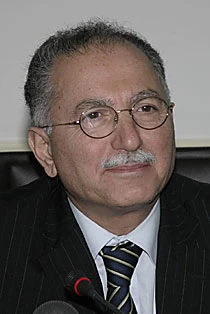
For the last two-and-a-half years it has been headed by the erudite and dynamic Turkish historian, Professor Ekmeleddin Ihsanoglu. At 64, he is a man with a mission. He is worried about what is happening in the Muslim world, but rather than wringing his hands in despair, he continues to give his all to his mission. “We can’t lose hope. These are difficult times, but we will continue with our efforts. We will not give up,” he said confidently in an interview with Arab News last week.
Ihsanoglu is aware of the huge expectations from the man on the street, and during his time as secretary-general, he has undertaken a series of measures to rejuvenate the organization. “My message to the people is to put their trust in the OIC and in the wisdom of its founding fathers who built a unique organization for serving the Ummah. I want their support. If we have the people’s support behind us, we will be able to take more steps forward,” he said.
Ihsanoglu tried to put the Islamabad conference into perspective. “Things didn’t go wrong there, they went slowly. There was no substantial critique of the draft of the new charter that was submitted to the member countries. The OIC submitted the best draft that it could. It has been two-and-a-half years since the idea was conceived in the Committee of Eminent Persons in Makkah in September 2005. The draft then went through the Committee of Experts, which worked for the Islamic Summit in Makkah in December 2005.”
The OIC secretary-general listed the names of those who contributed to the new charter. Former Turkish President Suleyman Demirel, former Malaysian Prime Minister Mahathir Mohamad, former Indonesian Foreign Minister Ali Alatas, former OIC Secretary-General Hamid Algabid, former Gulf Cooperation Council (GCC) Secretary-General Jamil Al-Hujailan, former Algerian Foreign Minister Lakhdar Brahimi and former UNESCO Director-General Moktar Mbow provided their input. “These people represent a spectrum of the most experienced leaders of the Muslim world who during their long careers had shown interest in the OIC and similar institutions. Their contribution to the new charter was significant,” said Ihsanoglu.
The revised text was then submitted to a committee of prominent Muslim legal experts. This committee carried out a study of the draft from the legal perspective. “It was this draft that came up for discussion at the Islamabad meeting,” said Ihsanoglu. “Naturally, there was no substantial critique of it. However, some countries felt that they needed more time to study and digest it. So what happened in Islamabad is that the ministers said: ‘We need more time.’ And that was the decision. It was decided that the charter would be finalized before next March, and it would be submitted for approval at the 2008 summit in Dakar, Senegal.”
Ihsanoglu said the charter would empower the OIC to address the issues that have caused such anger and resentment on the Arab street, but he emphasized that a proper charter was a prerequisite for the group to take effective action. “Now we are waiting for this summit in March. But, of course, I would like to appeal to the public opinion. The OIC cannot participate in a Formula 1 car race with a 1972 model with a broken engine and flat tires. We need to have a new vehicle to participate in today’s international races.” By 1972, the secretary-general meant the charter that was approved for the organization that year.
The OIC chief elaborated on his race-car analogy. “The new charter is the engine of the new vehicle. And then we have to have well-inflated tires, and this is the staff — the staff members. We are recruiting new staff members, and we would like member countries to provide us with skillful diplomats who have experience in multilateral diplomacy. The member countries have to support us politically and financially. That is the fuel for the engine.”
Despite attempts in the Western world to dismiss the concerns raised by the OIC about Islamophobia, accusing the organization of being soft on terror, Ihsanoglu renewed his absolute and long-standing condemnation of terrorism and again focused on the growing, unwarranted discrimination against Muslims. “The OIC is, and has always been, against terrorism,” he said. “This was the stand of my predecessors, and this is my stand as well. The OIC has always and in unequivocal terms condemned terrorism.”
The meeting on Islamophobia in Islamabad, he reiterated, was a thematic session focused on discrimination against Muslims and the defamation of Islam in the world. The session aimed at addressing ways and means of dealing with this phenomenon. “This was not meant to target anybody and does not mean that we condone terrorism. I would ask those who are attacking us to go through our website,” said Ihsanoglu.
In the session on Islamophobia, the OIC ministers had only called upon the international community to prevent incitement to hatred and discrimination against Muslims and to take effective measures to combat defamation of religion and acts of negative stereotyping of people based on religion, belief or ethnicity.
Although the OIC is preparing itself to become a successful agent for change in the world, every day tragedies unfold in Palestine, Iraq and Lebanon. So how does the OIC chief feel? “I feel worse than anybody else,” he said. “I feel more disappointed than anybody else. I see that situations are aggravated. We are trying our best through quiet diplomacy, through bilateral and multilateral contacts. We have to admit that situations in these crises are getting worse. There is a need for international cooperation to solve these problems. Major powers should take leading roles as honest brokers for solving these problems. We will always carry on our activities. We are committed to solving these problems, but we shouldn’t be simplistic in our approach. Simplistic approaches may actually create more problems.”