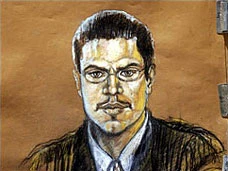
WASHINGTON, 10 June 2007 — Jurors in the terrorism support and conspiracy trial of Jose Padilla heard his voice on an FBI wiretap for the first time Friday, in a Miami, Florida courtroom. Prosecutors say the conversation proves he was getting ready to fight in a jihad overseas.
US District Judge Marcia Cooke limited what FBI agent John Kavanaugh could say about the alleged cell phone conversations. Cooke, for example, said that Kavanaugh could use the word jihad — not ‘’violent’’ jihad.
That distinction is significant because Padilla and his two co-defendants are accused of scheming to support ‘’violent’’ jihad overseas. The Miami indictment charges them with conspiring to ‘’murder, kidnap and maim’’ people overseas and to provide ‘’material support’’ for terrorist activity between 1993 and 2001. Each faces up to life in prison.
Along with at least two dozen decade-old tapes played for the jury this week, the conversation between Padilla, an American convert to Islam, and Lebanese-born Adham Amin Hassoun, the co-defendant accused of recruiting him — was cryptic and the exact nature of the mission is never named.
The discussions played for the jury covered mostly logistic matters: How to get a satellite telephone to Muslim rebels in Chechnya, how to get money to would-be holy warriors in the Middle East, how to move volunteers to Kosovo or Bosnia to help defend Muslims under siege by Serbian and Croatian Christians.
For the jurors, it was a global history lesson ranging back to the 1980s Soviet occupation of Afghanistan, involving complicated conflicts.
Prosecutors jumped from year to year and battle to battle in a presentation apparently aimed at providing the jury with a glossary of allegedly coded language, such as using the word “tourism” in the place of jihad, “getting married” for killed in battle, “green goods” for money and “iron” for weaponry.
The overall effect of the rapid-fire tour of the world’s hotspots might have been to show the jury how keenly Hassoun and the third defendant, Kifah Jayyousi, followed the fate of Muslims under attack abroad and how passionately they sought to help them. The tone and language of the talks also may have left an impression that the men were trying to hide something and up to no good.
But there has been no mention in the evidence presented so far of any intent by the three defendants to murder, maim or kidnap people in foreign countries, the wording of the conspiracy charge against them.
Nor has any evidence been presented that the Muslims whom the accused sought to assist were then considered or identified as members of terrorist organizations.
US eavesdropping on Hassoun and Jayyousi began in 1993 and covered more than 300,000 phone calls over the dozen years before their 2005 indictment on the terrorism support charges.
In a July 1997 intercepted phone call, Hassoun tells Padilla in English that “the most important thing is that you tell me you’re ready.” The FBI’s lead investigator in the case testified that Hassoun was talking about going to an area of jihad, or Islamic holy war. “God willing...it’s going to happen soon,” Padilla later adds: “Believe me, brother, it’s going to happen soon,” he says in a deep, tough-sounding voice. He left South Florida for Egypt 15 months later, from there he made his way to Afghanistan in 2000, where prosecutors say he filled out a form to attend an Al-Qaeda training camp.
Prosecutors say Hassoun recruited Padilla to fight for extremist causes overseas as part of a North American jihad support network. Hassoun, who was a prominent speaker and fundraiser in South Florida mosques, met Padilla while both were living north of Miami.
Padilla, Hassoun and Jayyousi are charged with being part of a support cell for extremist groups worldwide, including Al-Qaeda.
Hassoun, a computer programming expert from Sunrise, Fla., and Jayyousi, who has a doctorate and previously held senior education administration positions in California and Michigan, appear to have come to the attention of US security due to their contacts with Sheikh Omar Abdul Rahman. A radical Egyptian cleric, Rahman was convicted in the 1993 bombing of the World Trade Center.
Padilla, a 36-year-old US citizen, was arrested in May 2002 at Chicago’s O’Hare International Airport on suspicion of plotting to detonate a radioactive “dirty bomb” in the United States. He was held as an enemy combatant for 3 1/2 years before he was added in 2005 to the Miami terrorism support case, which does not include the “dirty bomb” allegations.
On the July 1997 tape, Padilla complains at one point to Hassoun that Youssef “talks too much” and then Hassoun reminds Padilla to be careful on the telephone.
Hassoun’s wife, Nahed, commented to one caller — who phoned to convey suspicions that Hassoun was under surveillance — that “we know that the lines are always...always monitored, but Adham doesn’t care...he talks.”
Prosecutors will likely continue to play FBI wiretap tapes when testimony resumes Tuesday. The trial, which wrapped up its fourth week, is expected to last though the summer.