JEDDAH, 16 June 2007 — The general perception is that Urdu poetry is all about love — and perhaps rightly so.
Ghazal, the most popular genre of Urdu poetry, is essentially a conversation between two lovers.
But on Thursday night, a young and little known poet from the western Indian state of Maharashtra gave ghazal a new meaning by drawing upon a popular verse from the Holy Qur’an:
Watu Izzu Mantasha, Watu Zillu Mantasha.
This verse from Surah Al-Imran, which is extensively quoted by the faithful, simply means Allah honors those He is pleased with and disgraces those He is not happy with. Altaf Zia used this verse to compose a very interesting ghazal that became a raging hit with the capacity crowd at the annual mushaira organized by the Consulate General of India at the International Indian School, Jeddah.
The crowd was packed inside a hot auditorium, while outside the lucky latecomers sat in an overflow space, a playground where the cool sea breeze mixed with poetic verse, causing the fronds of the nearby date palms to shimmer and making for a pleasant evening under the stars.
Nadaan Ko Is Baat Ka Bilkul Nahi Pata
Watu Izzu Mantasha, Watu Zillu Mantasha
Allah Ke Huzoor Ye Hota Hai Faisla,
Watu Izzu Mantasha, Watu Zillu Mantasha
Khush Ho Rahen Hain Mujh Pe Jo Kichad Uchhaal Kar,
Din Aa Gaya Qareeb Ab Unke Zawaal Ka;
Qudrat Karegi Dekhna Un Sab Ka Faisla,
Watu Izzu Mantasha, Watu Zillu Mantasha
Two other reasons for Zia’s popularity was his melodious voice and a theatrical way of presenting his compositions. However, not everybody was satisfied. Some said he was engaging in too much histrionics. One fellow poet, in fact, described him as a “performing artist” in the mold of Rahat Indori.
Zia was not the only surprise package at the very well-organized and well-attended mushaira. There were others, too, such as Muzaffar Razmi, from Kairana in Uttar Pradesh’s Muzzafarnagar district. He struck an instant chord with the audience with his famous couplet that is on the lips of every Urdu lover in the Indian Subcontinent.
Yeh Jabr Bhi Dekha Hai Tareekh Ki Nazron Ne
Lamhon Ne Khata Ki Thi Sadiyon Ne Saza Payee.
I.K. Gujral read this couplet when he took his oath as the prime minister in 1997.
Razmi’s diction and compositions were beyond compare. Ghazal is known for its lyrical qualities. In Razmi, ghazal is at its peak and pinnacle. His diction is fresh, his phraseology unique, his coinage of metaphors superb, his imagery picturesque. His fans hung onto his every word of every couplet. His thought content was a perfect match to the lyrical attribute of the ghazal.
Then there was Rahi Bastawi from Basti in Uttar Pradesh, famous for his geet, another popular form of Urdu poetry that is hugely popular in the north of India. He was highly successful and his “Are re re na baba” was being crooned by the audience much after the five-hour poetry-reading session was over.
Dr. Qasim Imam from Bombay surprised the audience with his excellent anchoring and beautiful poetry. Two particular couplets from him sent the audience in a crescendo of wah-wahs. Both had political overtones, but their instant popularity was indicative of the truthfulness of the message behind them. One was:
Sher Dil Log Pehente Nahin Chehre Pe Naqab
Apni Phansi Ko Bhi Aasaan Bana Dete Hain
And the second one was:
Ji Atalji Aapko Is Gham Pe Rona Chahiye
Dard Ghutne Mein Hai, Thoda Dil Mein Hona Chahiye
Dr. Farooq Shakeel from Hyderabad was successful in driving home some very poignant and interesting points. His tanhaiyan bolti hain miyan was very well-received. His couplet: “Apne Markaz Se Bichhad Ne Ki Saza Paate Hain/ Shaakh Se Toot Ke Patte Jo Bikhar Jaate Hain,” was also a hit.
Dr. Shahnaz Nabi, from Kolkata, wowed the audience with excellent and meaningful poems in a refreshing idiom. She received quite an applause. Associated with Urdu Academy, Kolkata, she has been in the forefront of giving Urdu poetry a new dimension by talking about the problems of the day. Her play with words was excellent though her presentation was a little difficult to follow.
Ali Zaheer from Hyderabad was inimitable. He rendered some of the choicest couplets that are in the Urdu poetry. His play of words was masterly and his couplets had that scholarly air. This one, for instance:
Ek Maidaan Mein Pada Hoon Na Hai Diwar Na Dar
Be Makaani Mein Yeh Dastak Ki Sada Kaisee Hai
Then there was Naeem Akhtar from Burhanpur, where his couplet “Har Koyee Masroof Hai Mahal Ki Taameer Mein/ Bhool Gaya Aadmi Qabr Ki Gehraiyan” was strongly applauded.
Dr. Naseem Nikhat was excellent and it was she who made the crowd remain glued to their seats till the very end. She recited beautiful couplets and her melodious voice kept everybody spellbound.
Dr. Naseem was a treat to hear; her treatment of ghazal is off-the-beaten track. She finds for herself new “radeefs” and “qafiyas”. Ghazal, which had become notorious for its monotonous and overworked and overwrought rhymes, and “radeefs” is treated by Dr. Naseem with a new and fresh idiom and images. She stole the event with highly romantic couplets.
Then there was Dr. Shafi Sagar. His satire was reflected in his delicate compositions. He made the audience laugh out loud. Rabab Rashidi from Shahjahanpur too recited some memorable couplets. Mashaf Iqbal Tauseefi from Hyderabad was the pick among the elder poets. His “Dekhen Kya Kar Rahi Hain Tanhai, Aaj Apne Hi Ghar Pe Dastak Den” was superb.
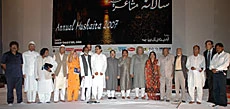
The president of the mushaira was the erudite poet from Delhi, Rifat Sarosh. He is one of the greatest exponents of Urdu poetry in all its forms and gifted with a rare mode of thought and feeling about love and rebellion. He has given a new meaning to the craft of Urdu poetry.
Going by the large number of people who turned up for the mushaira, it was a record of sorts. The school’s grand auditorium was packed with poetry lovers and an equally large number were seated in the school grounds where the mushaira was beamed live on a huge screen.
The poets at the event came from across the length and breadth of the country. Consul General Dr. Ausaf Sayeed, in his inaugural address, said: “Care was taken to represent almost every region in India. In line with the philosophy of not repeating the poets year after year, new faces were invited. And while they were new to Jeddah, they are well-known in India and have authored very many books.”
According to the consul general, the idea is to introduce “academic poets” to the people here in Jeddah. Poets who are being read through their books and through magazines but who have not been “performing artists,” so to say.
Rifat Sarosh and Dr. Qasim Imam praised the efforts of Dr. Sayeed for giving a new turn to the composition of mushaira.
Earlier, Dr. Suhel Ejaz Khan, Haj consul and director of India Forum, welcomed the poets. The event went on for five marathon hours, with the crowd remaining glued to their seats till the very end, screaming “Mukarrar, mukarrar.” Encore, encore.