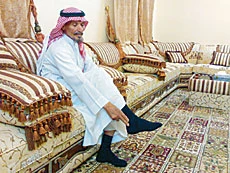
TAIF, 22 June 2007 — The art and science of tracking has been practiced as long as humans have been around. It is a tradition that originated among nomadic people who, for example, followed the migration routes of animals. Many tribes in Saudi Arabia also have this tradition, from hunting down prey to finding lost camel herds. Today, tracking might also be employed to collect crime scene evidence, especially in rural areas.
Awaad Al-Nafi is one of the oldest trackers in the southern Asir region. He wouldn’t say how old he is specifically, either because he is being coy or because perhaps he is not sure, but he says he is well over 60. As a man of traditional customs, he began his talk with Arab News by formally introducing himself.
“My name is Awaad ibn Dakheel Al-Nafi Al-Otaibi,” he said. “People call me Abu Muhammad. I started practicing this profession when I was 12 years old. I recognized a man who robbed my father’s livestock. Through tracking I identified who stole my dad’s sheep. He turned out to be the criminal and that’s how my tracking profession started.”
In the movies, tracking is often ascribed to a particular race of people. The Native Americans of the central plains and the Southwestern United States are often stereotyped by Hollywood as having almost supernatural tracking abilities. But this idea that the skill of tracking is stronger in certain groups of people is also prevalent in Saudi Arabia.
Al-Nafi says that people who become well known for having superior tracking skills are given the nickname “Al-Marri”, which is the name of a well-known tribe that would take caravans back and forth from the southern Najran region, across Saudi Arabia’s Empty Quarter, to what is today the Eastern Province of the Kingdom. The Al-Marris survived in the desert by being able to follow tracks in the shifting sands to oases in the Empty Quarter, a region that even today can be dangerous to cross even when you are equipped with the aid of modern technology and GPS.
“Al-Marri is a name given to distinguished trackers because the name is associated with a very long history in the art of tracking,” said Al-Nafi. “The nickname is not given to just any tracker. It has to be earned.”
Al-Nafi dismisses the idea that there is some inherited genetic link to tracking. He says he was born with the God-given ability, but that most people simply learn the skill from the previous generation’s masters.
“Neither my father nor my grandfather was a tracker,” he said. “The art of tracking is a gift from God. However, people can learn and train how to become trackers. The learner must be a genius possessing unique skills in addition to his desire and passion to learn.”
Al-Nafi says that he is most often asked to use his talent to track people rather than animals. “People choose me to shed the light on crime,” he said.
He says he has been asked to look for vehicle tracks, and he sheds some light on how he does it.
“It’s easy to track specific vehicles or people even on sandy surfaces as long as they appear on routes that aren’t used as much. It’s more difficult to track a car on a main road unless the road has been used very little in a 12- to 24-hour period.”
Al-Nafi says it is possible to estimate an age-range and even the gender of the person based on his or her tracks. “A young man’s footsteps are light,” he said. “An older man treads more heavily.”
The tracker even goes so far as to say he can tell rather intimate details about a woman’s step. “When the woman is a virgin, her step is heavier at the toes area,” he said. “The married woman’s footstep is heavier at her heels.”
While this seems to be an unusual and perhaps unbelievable claim (the man also says he can tell the race, height and weight of a person by the foot size of the print) it’s clear that Al-Nafi is able to find evidence to crimes. He was once able to find a vehicle used in a robbery by tracking the vehicle over 10 km over asphalt and sand. He even recognized the particular brand of tire on the vehicle. In another instance he was able to track three suspects who had stolen tires of a particular vehicle.
Al-Nafi also recounts the time he was able to find a runaway maid. “It was a challenge to track traces in a rocky area, but I managed to identify where the maid was and found her,” he said.
In another instance, Al-Nafi says he tracked a thief, but that other trackers disputed whether the man was the right suspect. “I was so embarrassed at the time and it was a very difficult situation,” he said. “But then while discussing the details, the arrested man fled the scene and it was clearly the right suspect. He was then rearrested and imprisoned. I was relieved and happy that I didn’t mislead the police.”