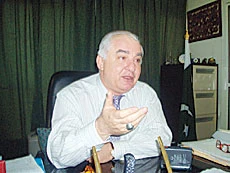
JEDDAH, 29 June 2007 — Pakistan Consul General Masood Akhtar is a diplomat par excellence, for he has fine-tuned the art of diplomacy to the basics — people. And he got to practice this art well early in his life when he secured the discipline, deference and dignity to mold him into what he is today — the poet diplomat.
Born into a Pathan family that put emphasis on word service, Akhtar, in his wide-ranging farewell interview with Arab News yesterday, reminisced about all the things that he holds dear.
“My upbringing, at home and boarding school, taught me these basic things — seek guidance from your Creator, respect and serve your elders and have dignity in serving as well as being served,” he said. “I have relatives who are in high posts and those who hold ordinary jobs. But all their experiences have been the book from where I learned,” he said.
In this era and time, when many a person seek succor and guidance from God, the Pakistani consul general is no different as he says, God the Almighty is his illuminator.
But it is his vision of seeing goodness in people that has led him to become not only a functional diplomat but also a catalyst and a unifying force to diverse ethnicities and cultures. Therein lies his popularity.
Akhtar’s popularity also stems from the fact that he believes in his work — that is to provide a service with the utmost of care. A simple word of encouragement, a proffered ear for their troubles, a ready smile to all and his instinctive knowing of the people and their moods all make for a day’s work for him.
“When I came in initially here, unfortunately, I had a long line of my predecessors who had for one reason or the other not completed their assignments or stay, which is normally for three years,” he said.
Akhtar went on to say: “As such psychologically I knew it was something difficult that I was coming for. Moreover I had never been in the Middle East. But there was always this craving and urge of coming here. Despite having traveled widely with my former prime ministers and presidents I had never stepped on Saudi soil.
“I would always refer things to my Creator saying what have I done that You have not given me this unique and distinct honor to step on this holy land. When I was posted here, among the first few things that I decided to do was to bridge the gap that existed between the consulate and the community. And I felt the lead had to come from me.
“When I came here I realized that the consul general was being seen as a mafia chief who has all the powers. I felt that was the worst kind of a description to be given for anyone who represents his country. As such the first few steps I took were that I would ask my drivers that they would not open the door for me. I would do that myself. I would ask my assistant not to carry my bag... I made an effort that I should be the first one to wish anyone irrespective of who he or she was.
“I am from a rural background myself but all this Westernization in terms of my dress and the English language is because I was brought up in a boarding school. Within my own family I had an uncle who was an ordinary soldier and I had another uncle who was a general. I had somebody of the level of a grandfather, who is the chairman of the board of a health organization. I had another uncle who was inspector general of police in West Pakistan.
“We Pathans believe in respecting people by their age and not by their rank. As such I have got up to give my seat to my barber who cut my hair in the village. And the fellow who took me in a tonga (horse-drawn carriage) I would always be most happy to leave my seat for him.
“I am a humble being. Being a poet is like having good looks. It is an additional honor God has bestowed on me. Before coming here, I had seen all the pomp and show when I was in uniform.
“When I was in my boarding school there was this one sentence said by my geography teacher. I believed in it. I acted upon it. With God’s blessings it earned me a lot of success. That sentence was: “Son, if you can kill a man with sugar, don’t give him poison.” I had to win people and not subjugate them. With that humble approach I won a lot of people. I made them feel I was one among them.
“In the first place I inherited poetic sensibility from my parents. My mother, an uneducated woman, would cry on hearing a couplet of a song. She is alive and she remains my inspiration. The sensitivity always existed. It just needed a channel and that came in the form of poetry. I think I do not live as a dreamer. I may be a dreamer by birth in terms of being a Cancerian. But as I tell a lot of my friends: ‘I am the curable cancer.’
“Diplomacy basically means building bridges. For me nobody is an enemy. Our Creator is the same. That is the biggest bonding factor. I had served in India. A Pathan historically approaches things differently. That is why you find a lot of successful Pathans in India. When I came here, the first person I called was the then Indian Consul General Syed Akbaruddin. And I told Akbaruddin, “Look I have not come here to compete with you. I have come here to learn from you. From your experience. I will be more than honored to come if you invite me for any occasion.”
“The first breakthrough came in the form of a qawwali session organized by the Indian Consulate where I was the chief guest. The next morning I heard murmurs of protest. The whispering campaign went on. All my colleagues here at the consulate then went against me. I didn’t mind what they were saying because I knew exactly what my intentions were.”
My experience with Akhtar was as stark as was fleeting — four times in all during his tenure in the high office here. All four times I came away with a new facet of the man, not the diplomat.
When India and Pakistan resumed their cricketing diplomacy with a friendship series in March-April 2004, my Editor in Chief Khaled Almaeena hit upon the novel idea of sending me — a non-Muslim Indian — to cover the series.
The prospect of visiting Pakistan was alluring. Especially after I had already developed affinity and friendship with many Pakistanis whom I met at work or during the course of my work in the Kingdom.
Already the myths and misconceptions that I had held in India about our neighbor — especially after the two had gone to war on two occasions when I was in India — had been laid to rest. For contact was the beginning of understanding, and understanding the prelude to trust and it is only with trust that you become friends.
Though the occasional nationalistic repartee and horrific incidents back home brought about a rise in the body mercury — on both our parts — rarely did it pierce the bond that was slowly and surely firming.
The sudden move to send me, with the series already under way, brought about the eternal question — visa. Will I get it soon enough? A phone call to the consul general brought this response... “Sure come today.”
It was 11 in the morning. “Will there be enough time, and I do not have the form,” I asked? His reply was, “Just come. But bring some photographs and Sohail Khan (the then information consul) will assist you.” I went with my Pakistani colleague, as I did not know the exact location of the consulate then, and met Sohail, who too became a good friend despite it being his job to cultivate the media.
From there on it was a breeze. The paperwork was ready, and the passport sent to the concerned department to be stamped. While all the process was happening, Sohail escorted me to Akhtar’s office.
As they say first impressions are last impressions... For me it was a lasting one. There I saw a strikingly handsome Pathan, elegantly attired, showing an alacrity as he got up from his chair to meet me. With outstretched hand he shook my hand, dragged me to his bosom and in the traditional Subcontinent greeting, embraced me. All the while he was keeping a running commentary of warm welcome. I was simply blown away. My reactions were perfunctory as I took my time to adjust to the effusive welcome.
It was here that I got to know the diplomat.
“Let’s talk about my country, which you are going to visit. You go there and see for yourself and make up your mind,” he said. There was no spiel about Pakistan, no pressing of literature about the country, and no cautionary note about the dos and don’ts for an Indian in Pakistan.
He shifted tack quickly as we got on to international politics and the shape of the world. Again the perceptive man brought the issues down to the basics — people and trust. And after we agreed to disagree on certain issues, he regaled me with some light asides before springing on me that I have many friends in India still. “I did a stint briefly in Delhi and they are the ones I still hold dear... Just a phone call and they still do what I ask... This is what I want in the Subcontinent — friendship and trust with all benefiting.”
We were interrupted then with my passport arriving with the “cricket visa,” and I thought with the job done, my meeting of well over an hour, would end soon. After all he had loads of other things to do. As I was getting up to take my leave, he quipped, “Kahan jaa rahe ho, ab to mulaqat shoroo hui hai (Where are you going, our meeting has just begun).”
After returning from Pakistan I met him for the second time. He had called me up to congratulate me on my Pakistan diaries. I went to thank him for all his efforts. And then on the third occasion I met him at the farewell dinner for my other friend Sohail, who was posted back to Pakistan. A somber occasion, but Akhtar made it light by sharing with us the backroom tussles and anecdotes of Sohail, whom we wished every success. And then during this interview, where he opened his heart to us.
He took me to his bosom when I met him first. When he is leaving, I told him at the farewell dinner he had organized at the Marhaba Restaurant on June 25, that “You’ll always be in my heart.”
The poet diplomat showed that it takes two to tango. And hopefully his emphasis on people-to-people diplomacy will prove to be the basis of not only peaceful coexistence between India and Pakistan, but the foundation for the two nations to march step in step toward progress and prosperity.