RIYADH, 4 July 2007 — They loiter close to courts, Passport Department offices, governorate buildings, and anywhere where an official petition is needed for submission.
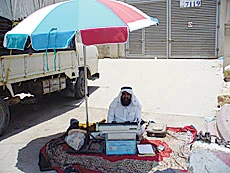
The only thing they have in their possession is an umbrella that protects them from the immense glare of the sun, a dusty old typewriter and some white paper.
Saudis might have done away with pagers, cumbersome typewriters and regular phone lines, substituting them with cell phones, laptops and wireless networks, however, petition writers — or rather unofficial legal advisers — have defied the change of time and advancements in technology.
They still do what they do best: write petitions. And they do it with style, the old style that is, typing it down on a typewriter or even writing it by hand.
Do not be fooled by their humble appearances. They can offer you legal advice that would shame a local attorney. Their years of experiences of dealing with legal institutions have made them valuable assets. It would only be fair to call them the “Insiders.” They know the flaws within the legal system. They also know what needs to be done and who to approach.
People often turn to them as unofficial legal advisers to avoid outrageous lawyer costs. Arab News met two petition writers near Riyadh’s main court.
Safar Al-Ghamdi, 55, has been in the business of petition writing for 17 years. He says that educated people in the Kingdom should not take them for granted. “We know the system inside out. We know how to operate the keys,” he said.
“Don’t be amazed at what I’m saying. Appearances can be deceiving. Officers, academics and even professors sit here before me... All of them are in need of my experience to write down what they need to convey to an official in short, comprehensive and straight forward language,” he said.
Over the years, standing near the court has enabled him to hear firsthand stories of drug abuse, family disputes, divorce cases, legal financial disputes and others.
“I once wrote a petition letter for an elderly man, who had bruises on his hand. He told me that his son beat him and that he was threatening to set the house on fire,” he said.
“He confessed to me that his son told him that he was the one who set his car alight,” said Al-Ghamdi, highlighting the type of cases he has dealt with.
The majority of people who seek his services are unaware of the legal system and even of their legal rights. “Some don’t even know who to approach? The court, the governorate, or the labor office?” he said.
Al-Ghamdi ends up working with all types of people. Sometimes, stubborn people insist he writes for them letters to the governor of Riyadh, even though he knows the case should be directed elsewhere.
The 55-year-old wonders why unemployed university graduates do not take up a job like his, since it only requires a little knowledge of the legal system and an ability to listen to people. “Experience comes with time,” he explained.
One of the things he and his fellow colleagues mourn about is not having proper kiosks to operate from. Al-Ghamdi said he does not mind paying a small sum of money to the municipality to build a proper structure near the court.
“I’m asking the mayor of Riyadh to have mercy on us. I’ve been suffering for 17 years. We all suffer from the sun, rain and wind,” he said.
Another petition writer, who preferred not to be named, said public demand for their services was the secret behind petition writers being in the business for such a long time.
“They avoid going to legal consultants who require large sums of money even before going to court,” he said, adding that the money he earned was not brilliant but helping people was a blessing. “We sometimes offer legal advice and point out to people necessary steps that need to be taken,” he said.
The petition writer said he earns approximately SR80 a day, charging each customer SR10 — a small price to pay for an unofficial legal adviser.