ISLAMABAD, 4 July 2007 — Pakistani paramilitary and police forces fought pitched gunbattles with students at the Red Mosque in the capital yesterday as a long standoff exploded into violence, leaving nine dead and over 100 injured.
Clerics at the mosque threatened suicide attacks to avenge the “blood of martyrs” after the daylong clashes, which killed a soldier, four students, a journalist and three bystanders.
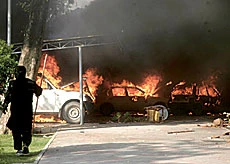
The students later pelted two government buildings, including the Ministry of Environment, with rocks and set them ablaze, and torched a dozen cars in the ministry’s lot.
The battle marked a major escalation in a six-month standoff during which the clerics have challenged the military-led government by mounting a vigilante anti-vice campaign in Islamabad.
Trouble began when student followers of the mosque, including young men with guns and dozens of women wearing black burqas, rushed toward a nearby police checkpoint early yesterday afternoon.
Police and paramilitary Rangers fired tear gas and, as the students retreated, at least four male students, some of them masked, fired shots toward the security forces about 200 meters away. Gunfire was also heard from the police position.
A man used the mosque’s loudspeakers to order suicide bombers to get into position. “They have attacked our mosque, the time for sacrifice has come,” the man said.
Hours later, dozens of students were patrolling the area around the mosque, and sporadic shots were still heard.
Security forces, some riding in armored vehicles, cordoned off the area with barbed wire and checkpoints and continued to fire tear gas at the demonstrators from a distance. Shops in the area, about four kilometers from the government district, were shuttered.
Deputy Interior Minister Zafar Warriach said officials were in touch with the mosque administration to try to defuse the situation. “Despite provocation from the Red Mosque, we are not using force,” Warriach said on state-run Pakistan Television. However, Warriach said it was the duty of the government to protect the life and property of its citizens, and “we will do it.” Shah Abdul Aziz, a lawmaker for a hard-line religious party who rushed to the mosque to mediate, emerged to say that a cease-fire had been agreed — only for the shooting to continue after he left.
Aziz said the mosque’s leaders claimed that 10 of their supporters had died, including two female students. “This matter can be resolved through dialogue. Force is not the solution,” Aziz said.
Some of the students carried gas masks and several were seen with gasoline-filled bottles and Molotov cocktails. About a dozen were armed with guns, including AK-47 assault rifles. Abdul Rashid Ghazi, the mosque’s deputy leader, said the Rangers sparked the trouble by erecting barricades near the mosque.
“The government is to be blamed for it,” he said. When asked about the presence of armed students at his mosque, Ghazi said they “are our guards.”
S.M. Pasha, a doctor at the Polyclinic Hospital, said three people had died at the hospital, one student, one laborer and one soldier. Two policemen died of bullet wounds at another clinic, an Interior Ministry official and a doctor said. Both asked for anonymity because they were not authorized to talk to the media.
Doctors at various hospitals said they had admitted about 100 people. Most were suffering from the effects of tear gas, but they also included several students — both male and female — with bullet wounds, the medics said.
Witnesses said a newspaper reporter and a cameraman were caught in the crossfire and taken to a hospital with bullet wounds.
Authorities have been at loggerheads with the mosque for months over a land dispute and after its followers began a campaign to impose a Taleban-style version of Islamic law in the capital.
Students have carried out a string of kidnappings of police officers and alleged prostitutes, including several Chinese nationals, and have threatened suicide attacks if security forces intervene. Critics have lambasted the government for negotiating with the clerics instead of arresting them, and blamed President Gen. Pervez Musharraf for the creeping “Talebanization” of Pakistan.
Musharraf said last week that he was ready to raid the mosque, but warned that militants linked to Al-Qaeda had slipped inside and that the media would blame any bloodbath on the government.
But he has held off largely for fear of causing casualties among the thousands of students — especially the women, most of whom hail from Taleban-sympathizing areas along the Afghan border.
— With input from agencies