ISLAMABAD, 5 July 2007 — Security forces arrested the chief of the Red Mosque in the capital as he tried to flee while disguised in an all-covering women’s burqa yesterday, officials said. More than 1,000 of his followers surrendered as troops backed by armored vehicles and helicopters tightened their siege of the complex, officials said.
Female police officers searching women fleeing the mosque’s madrasa discovered Maulana Abdul Aziz under a black head-to-toe veil, said Khalid Pervez, the city’s top administrator.
“I can confirm his arrest. He was trying to escape with the girls and was wearing a burqa,” Information Minister Mohammad Ali Durrani said.
Officials said he was caught along with his wife Umm Ehsan in a screening center set up in a school near the mosque to check people leaving the mosque.
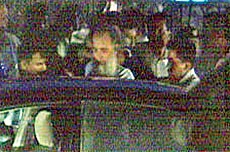
An AP Television News cameraman saw plainclothes police bundling the gray-bearded cleric into the back of a car which sped away.
“We caught Abdul Aziz when he was trying to escape the mosque clad in a burqa. He did not offer any resistance,” added a top security official involved in the capture.
“He was the last in a group of women all wearing the same clothes. He was wearing a burqa that also covered his eyes,” the official said on condition of anonymity.
“Our men spotted his unusual demeanor. The rest of the girls looked like girls but he was taller and had a pot belly.” His arrest defused the tension around the mosque, where troops in armored personnel carriers enforced a shoot-on-sight curfew imposed early yesterday after the violence.
Students had exchanged automatic gunfire with security forces as night fell, after police fired tear gas shells at the compound to drive out more radicals holed up inside, officials said.
“They have no options but to surrender,” said Javed Iqbal Cheema, a government spokesman. “The government is not into dialogue with these clerics.”
As evening fell, sporadic gunfire erupted around the Red Mosque, and at an adjacent women’s seminary while three helicopter gunships circled overhead.
Scores of police and soldiers, some armed with sniper rifles, watched as male and female seminary students filed out of the compounds. A number of the women were in tears.
The city’s deputy administrator, Chaudhry Mohammed Ali, said more than 1,000 had surrendered.
“They can be a few hundred, they can be more than that,” Minister of Information Durrani told reporters about the estimated number remaining inside the complex. It was unclear how many of those were hardened militants.
One of those who decided to give up, 15-year-old Maryam Qayyum, said many had decided to stay in the seminary.
“They are happy. They only want martyrdom. They don’t want to go home,” she said.
The government said all women and children would be granted amnesty but males involved in killings and other crimes as well as the mosque’s clerics would face legal action.
The mosque’s deputy leader Abdul Rashid Ghazi said earlier he was prepared to talk with the government but added, “We will continue to defend ourselves.”
Qayyum said mosque leaders were not trying to stop students from giving up. But her mother, who had come to take her home said, “They are making speeches. They want to incite them.”
The events came after a day of bloody clashes at the mosque on Tuesday between security forces and armed militants holed up in the sprawling mosque, which has been at loggerheads with the government for months. The clashes left 16 people dead.
The bloodshed added to a sense of crisis in Pakistan, where President Gen. Pervez Musharraf already faces emboldened militants near the Afghan border and a pro-democracy movement triggered by his botched attempt to fire the country’s chief justice.
The mosque siege sparked street protests Tuesday in the cities of Lahore and Quetta organized by radical religious parties.
A senior government spokesman, Anwar Mahmood, said the number killed in Islamabad had risen to 16, but declined to give a breakdown of the victims. Earlier, the government said they included militants, innocent bystanders, a journalist and members of the security forces.
Ghazi told the AP that 20 of his students had been killed by security forces, including two young men as they were climbing to the top of the mosque for morning prayers yesterday. He said sniper fire was being directed at the compounds.
The violence dramatically deepened a six-month standoff at the fortress-like mosque, whose clerics have challenged the government by sending students from the mosque’s madrasas to kidnap alleged prostitutes and police in a Taleban-style anti-vice campaign.
Some accuse intelligence agencies of encouraging the crisis to justify prolonging military rule — a conspiracy theory with considerable traction in Pakistan’s intrigue-ridden politics.
— With input from agencies