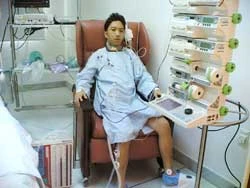
JEDDAH, 9 July 2007 — Weeks ago, 22-year-old Exequiel Calaguas was resigned to the thought of having a short life. Diagnosed with tetralogy of Fallot, a congenital heart defect known to be the most common cause of blue baby syndrome, he had been told to accept his fate that he would expire very soon.
Today, the eldest in a brood of three is now making long-term plans thanks to the employer and superiors of his mother in Jeddah who generously gave him a second life. The young Filipino man underwent an open-heart surgery recently at the International Medical City (IMC) in Jeddah and his doctors have declared the operation a success.
“The operation was risky but we can now say the result is great,” said Dr. Mishal Ghandour, the director of the IMC’s Surgery and Critical Care, who led a team of surgeons in the open heart surgery on June 27. According to Ghandour, he was surprised to know that the young man was still alive because people born with this condition, he says, seldom reach the age of 21.
Tetralogy of Fallot refers to four types of heart defects present at birth.
The condition causes too little oxygen levels in the blood, which leads to cyanosis or bluish-purple coloration to the skin, thus the term “blue baby.”
At birth, infants may not show the signs of the cyanosis, but later may develop sudden frightening episodes (called Tet spells) of bluish skin from crying or feeding.
In addition to cyanosis, the symptoms include difficult feeding (poor feeding habits), failure to gain weight, passing out, clubbing of fingers (skin or bone enlargement around the finger nails), squatting during episodes of cyanosis, and sudden death.
Outpouring of Support
How the young man’s case reached the attention of IMC doctors and officials was itself sheer luck. Exequiel’s mother, Teresa, a dental hygienist at the hospital, was arguing over the phone with her son, who was in the Philippines, and was overheard by Dr. Yasser Alkhiary, chairman of the Dental Department.
Alkhiary apparently noticed the worried look on Teresa’s face. He asked why, and after Teresa explained the very dangerous condition of her son, he took pity and informed Ghandour about it.
Ghandour immediately called Teresa and told her to bring her son to Saudi Arabia so he can be treated at once. The initial plan was for Ghandour to recommend Exequiel’s case for help to two foundations he knew.
“But everything suddenly changed when my son arrived. I was surprised when I was informed that IMC will shoulder all the expenses for my son’s operation,” Teresa said in an interview.
The Fitaihi Foundation headed by Dr. Walid Fitaihi, the chairman of the IMC’s board of directors, had agreed to bankroll the entire procedure to give Exequiel another life.
Ghandour said Fitaihi did not hesitate in responding positively when told of the peculiarity of Exequiel’s case.
Preparation
Ghandour said they had to do a lot of preparation before performing the surgery.
“I remember the difficulty we faced when he came here. His hemoglobin count was 27. The normal is just around 12 to 14 but he had more than double and that constituted a problem because if we subjected him to surgery then he could have a lot of complications. He could have blood clot in his brain... So we spent three weeks preparing him,” he said.
After a series of check-ups and preparation, two minor operations were performed. The first called “cardiac cauterization for diagnostic findings” was done on May 29, during which the doctors pinpointed the locations of the blocked arteries and veins.
The second cauterization involved the ballooning and dilating of the arteries and veins that contracted.
On June 27, Ghandour and his team went for the third and final operation, the actual open heart surgery which started at 8:30 a.m. and ended at 4:30 p.m., or a total of eight hours.
Exequiel was then taken to the Intensive Care Unit and at 6:30 p.m. the incubation was removed to enable him to breathe from his lungs. Exequiel was discharged from the hospital two days later and is now resting in their temporary home in Jeddah’s Nada district.
Ghandour said Exequiel will undergo several check-ups to monitor the progress in his rehabilitation and will do regular exercises as part of the rehabilitation for the next two months.
Ghandour said: “I am very happy that I was a part of this very successful event that changed the life of this young man. Exequiel was very fortunate to have a new life. I am sure he is a wise man and he is going to make the best out of it. We also look forward to seeing his contribution to his society and to the whole humanity.
Exequiel’s mother is on leave from work to ensure that his son strictly follows instructions for his rehabilitation.
“One of the things that the mother would work on is to correct his son’s squatting habit. He should now sit normally,” said Zenaida C. Gagno, the nurse manager of IMC’s operating room.
She explained that Exequiel’s operation “was very delicate, one of a kind.” Surgery for tetralogy of Fallot is best done while the patient is young, and in most cases, when they are still babies, she said.
Exequiel’s mother was profuse with gratitude as IMC officials, doctors and staff saw her son off.
“God is great, indeed!” she said, enumerating the names of all those who made his son’s operation possible.
Brighter View of Life
In an interview at their home, Exequiel said he was extremely amazed with what he had been through and has started to appreciate life.
He said he had already accepted his fate, thinking that nothing could be done about his condition.
He said he initially refused to come to Jeddah, even delaying the processing of his papers, but the persistent prodding of his mother, his girlfriend and friends to grab the very big opportunity and the moral support and inspiration they gave made him change his mind.
He promised to strive hard to be someone someday and not disappoint everyone who helped him get a new lease on life.
Before his trip to Jeddah, he was taking up a two-year computer programming course at STI Computer College in Manila.
He said his successful heart operation has given him a brighter outlook in life and he now wishes to pursue computer engineering.
Abdurajik Samain, a welfare officer at the Philippine Consulate General in Jeddah, said the gesture of compassion shown by the officials of IMC was overwhelming.
“Consul General Pendosina Lomondot and myself express our sincerest gratitude to the International Medical Center’s officials and staff for the very generous help they gave to one of our compatriots,” he added.