MAKKAH, 10 July 2007 — Many people think that prisons are state-run venues used to house criminals. However, ashamed of their mentally and physically ill relatives, many Saudis are turning their homes into mini-prisons and treat their ill relatives worse than criminals, solely with an aim of hiding them from society.
Such people are being deprived of the simple right to live with dignity as normal members of society. Many are also sent to care homes where their families never visit or ask about them. Arab News painfully interviewed people directly affected by such draconian and old-fashioned attitudes that have made the lives of many unbearable.
Saad, a Saudi man from Makkah, lives next door to a family, whose nine-year-old daughter is handicapped. “The daughter is suffering from some type of mental illness. Her family has imprisoned her at home and refuses to allow her to leave. She suffers from epileptic fits and we hear her crying and screaming all the time,” said Saad. He added that sometimes the girl is allowed onto the roof of the house for a breath of fresh air. “We see her on the roof. The dad chains her to a chair so she can’t move and covers her mouth with tape so she can’t scream. It’s pretty sad the way they treat her,” he said.
The elder sister of Shaker, a Saudi citizen who asked his surname not be published, was mentally ill for years. “My family was ashamed of her and no one apart from our immediate family knew about her. For years people would come to our home and not know about her,” he said.
“My friends never knew that I had a sister until she died a couple of years ago. They all came to the funeral and were shocked that I hadn’t ever told them that I had an older sister,” he said. “When people came home, my parents would introduce all of the other children except for her,” he said, adding that he told his friends that he felt ashamed that his sister was mentally ill. “I feel terrible how we treated her. It shouldn’t have been that way,” he said.
Khaled (another Saudi man who asked his surname not be published) said his father imprisoned his uncle in a flat because he was mentally ill. “My dad made him live in an old building next to our home. He was in a bad condition and we hardly used to visit him. We used to feed him though. His food used to be passed to him through a window,” said Khaled, adding that the uncle remained like this for years until he died.
“I’m not too happy with the way my dad treats my eight-year-old brother who suffers from Down’s syndrome,” said a teenage Saudi girl, who refused to reveal her name.
“He treats him differently. Dad prefers my other brothers to him and so he feels isolated and hates our family. I’ve spoken to my parents on numerous occasions about this issue but with no effect,” she said, adding that her parents do not allow her brother to leave home in order to ensure people do not know about him.
Hind Al-Hindi, a sociologist at Makkah’s King Abdul Aziz Hospital in the Al-Zaher District, said that she has come across many cases of Saudi families treating their ill relatives badly. “There are cases of families neglecting their handicapped and mentally ill children. There are also cases of families abandoning such children on the street,” she said, adding that when families do that, they endanger the lives of their relatives and members of the public.
“Many families neglect them and refuse to take them to hospital for treatment. Some isolate them inside their homes because they don’t want people to know about them, or they don’t want them to harm other people or themselves. Others feel ashamed and feel that people will talk about them and so don’t let people know about them,” said Al-Hindi, adding, “It’s sad to see families isolating such people instead of helping them.”
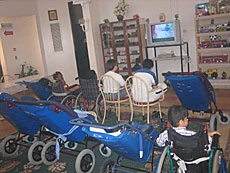
Arab New visited a rehabilitation center in Makkah and found that many of the patients inside were either physically or mentally ill. Many of those handicapped also suffer from mental depression as a direct result of their families’ ill-treatment.
Najwa Al-Ameer, a sociologist at the rehabilitation center, said it was important for families to help their handicapped or mentally ill children.
“It’s imperative that such families actually help them by accepting them as part of society. Sending the handicapped and mentally ill to rehabilitation centers and forgetting about them will not help them,” she said. Many of the cases treated at the center are cured within six months to one year.
“Mental illness, if neglected, could worsen and lead to early death. Many families are surprised when their children improve at the center. All they need is love and care,” added Al-Ameer.
Inside the center, Arab News met a woman in her 30s who is mentally ill and suffers from a physical handicap. She was crying most of the time because her family does not visit her.
There was another 24-year-old man, who is deaf and unable to speak. Speaking through sign language he said he wishes his family would visit him. Arab News also met a nine-year-old handicapped girl. When anyone speaks to her, she cries because she misses her parents, who never visit her.
Najlaa Reda, head of the center, said that depriving such people of the right to live with dignity in society is a crime. “Such things make handicapped people feel they are neglected and unwanted and may make them aggressive,” she said, adding that by providing them with love, they would have a better chance to lead normal lives.