
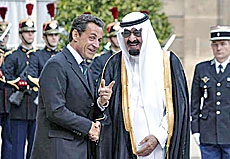
The Custodian of the Two Holy Mosques King Abdullah’s recent visit to Paris had opened a new chapter in the annals of Saudi-French relations. The visit was the Saudi king’s first official visit to France since his accession to the throne. His previous visit as crown prince was in April 2005. His latest visit came in the context of the strategic partnership established between France and the Kingdom in 1996. France is Saudi Arabia’s eighth-ranking supplier, while the Kingdom is its second leading trade partner in the region.
The visit strengthened dialogue on major international and regional issues, particularly the peace process in the Middle East, situation in Lebanon and Iraq, and the fight against terror. Matters of bilateral interest such as cultural and educational cooperation and training were also discussed in detail during this visit.
Following the king’s wide range of discussions with the French President Nicolas Sarkozy, a joint statement issued by the two head of states revealed that Saudi Arabia and France were studying the prospects of setting up a joint fund to finance scientific cooperation to launch new projects in the field. They also expressed their desire to sign an agreement for cooperation in higher education, training and research. The long-term agreement extending to several years will achieve major objectives. It will also bring about substantial increase in the number of Saudi students being sent to France for higher studies and activate cooperation between research centers in the two countries.
Last year, France and Saudi Arabia signed two defense deals that could pave the way for Saudi purchases of French helicopters, submarines, tanks and possibly Rafale fighter jets.
During his visit to Paris, King Abdullah referred to the six decades of friendship between Saudi Arabia and France and also congratulated Sarkozy on his victory in the May presidential election. The king also said France plays a crucial role in the Middle East. “France has an international standing that places on the country huge responsibilities and roles that it must fulfill, particularly pertaining to Middle East issues. The world will listen to the voice of France -- the voice of justice and fairness -- under the leadership of President Sarkozy.”
On his part, Sarkozy affirmed his wish to maintain France’s good relations with the Kingdom. The president said his country would continue under his leadership to recognize the Kingdom’s important position in the Islamic world and its influential position in the global economy. “The world needs the Kingdom in order to achieve peace,” said Sarkozy. “The world needs the Custodian of the Two Holy Mosques to find a way out of tension and clashes.” Sarkozy also accepted an invitation extended by King Abdullah to visit the Kingdom this year.
In the political sphere, cooperation between the two countries has been strong since the founding of the Kingdom by the Late King Abdul Aziz. France was one of the first to recognize King Abdul Aziz’s government in 1926.
The two countries signed the Al-Jazirah Pact in 1931. Saudi Arabia benefited shortly after that when France established a weapons factory in Al-Kharj. In 1929 France sent an economic delegation to Saudi Arabia followed by a diplomatic delegation in 1936.
In April 2005, King Abdullah, then crown prince, visited Paris and it was reciprocated by President Chirac’s visit to Riyadh in March last year. It was followed by a visit by Crown Prince Sultan, deputy premier and minister of Defense and Aviation to Paris.
French Ambassador Charles-Henri D’Aragon said: “The foundation of Saudi-French ties was laid at the historic meeting between President Charles de Gaulle and King Faisal during the mid ‘60s. Since then, they have grown from strength to greater strength reflecting the Kingdom’s stature in the Arab world and in the international community not only as the world’s largest oil producer but also for its balanced approach to international issues.”
The Kingdom has been playing a key role in encouraging stability and balance and moderation in the conflicts in the Arab world over the past several years. The Kingdom is one of France’s most important trading partners. According to the French Embassy in Riyadh, the volume of two-way trade reached $7.89 billion last year with Saudi exports accounting for $5.45 billion and French exports $2.25 billion. Trade with Saudi Arabia represents 20.6 percent of France’s total trade with Middle Eastern countries. Main French exports include barley, perfumes, poultry meat, pharmaceuticals, electrical equipment and clothing items and accessories. French imports consist mainly of crude oil and refined petroleum products, which make up for almost 95 percent of French imports from the Kingdom. Currently, France operates more than 60 joint ventures in the Kingdom.
The Saudi-French Center which was established in 1973, has its branches in Riyadh, Jeddah and Alkhobar. It offers various level courses in learning French as foreign language. These centers are open for men and women among Saudis and expatriates in the Kingdom. More than 1,500 students in the Kingdom are currently following these courses in the three major cities.
Meanwhile, Ambassador Aragon will host a reception today at his residence to mark his country’s national day. French citizens in the Kingdom and members of the diplomatic corps, government officials and local businessmen are expected to participate in the celebrations.