
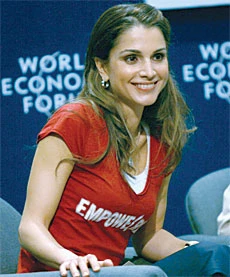
When Queen Rania of Jordan isn’t spending time with her four little princes, helping them with their schoolwork or just spending quality (and quantity) time with them, she spends her public time raising awareness of profound social issues that affect Arab women throughout the Middle East. The former Citibank executive who fell in love with a king and is now Jordan’s first lady, travels the region meeting the people who get little credit for their noble efforts toward fighting poverty, discrimination, misogyny and other social problems that not only affect women personally and profoundly, but can also lead some to perform horrendous acts of violence, inside and outside the home.
Sayidaty, the women’s weekly magazine and a sister publication to Arab News, sat down with the royal highness in her offices in Amman recently for a personal chat about the current and future state of Arab women.
How would you describe the cause of terrorism in the broadest possible terms?
There is a misunderstanding between two sides resulting from a lack of communication. This has caused fear and mistrust of the motives of the other side. The international community has not collaborated toward effective communication of the issues important to either side of this divide. Conflicts occur, which exacerbates disagreements and impede social harmony.
What do you make of the view many Western non-Muslims have about women wearing hijab?
The veil has become a political statement, partly as a result of the lack of communication that I just described. Many people judge Muslim women based on a submissive stereotype that is clearly false. This is wrong. A person should be judged on what’s in her head not what’s on it.
Despite this lack of effective communication, you always express optimism about the future of Arab women.
Yes, of course. I am optimistic about the role of women in general and in particular Arab women. Studies have shown that women in general are better than men when it comes to insuring the continuance of communication in spite of obstacles. I’ve seen women from completely different backgrounds build strong relations as peacemakers. Women tend to be very resilient in the face of showdowns, such as what you see in Palestine, Iraq and Lebanon. And they do this while raising children and instilling in them principles of forgiveness and respect.
What are the strengths and weaknesses of Arab women?
Arab women have made progress, but there is still a lot to be done, and I am optimistic that progress will continue to be made in social issues, economic participation and politics. I see progress being made in Jordan and in other Arab countries. Arab society recognizes the role of women and its importance.
Where do you place Jordanian women in this progress?
Jordanian women have been able to reach leading roles and achieve a lot for themselves, for their families, and for the country. This is because of their deep belief in the importance of women in this development. Jordanian women are now participating in different public and private fields and in civil rights movements.
How to you view the role of older women: Mothers and grandmothers?
They are the base. They provide us with experience and courage. We must not forget the Islamic principles that call for respecting mothers and the elderly.
What are the urgent needs of Arab women?
Education is crucial. We must set up an environment that helps women and girls build self-confidence and empower them to select their own roles and make their own choices.
What do you think about the progress of women in the Gulf region?
Gulf women have achieved a lot in many fields. I am proud of how they have overcome obstacles.
What is your role in non-governmental organizations?
My role is minimal compared to the role of local community members in these organizations. Needs vary by region and I basically just provide support and encouragement. We try to bring like-minded people and groups into larger organizations, such as the Jordan River Association, which is changing the lives of people for the better. They train women, help protect children and teach parents how to positively affect their children. The Association established the Bani Hamida Program, which has helped provide additional incomes for rural women.
What is a particularly terrible situation that has stuck in your mind?
Unfortunately there are many incidents that I cannot forget. But the image that is still in my mind is when that of the mothers of afflicted people and injuries in Aman bombings (Nov. 9, 2005). I still think of the families and the the injured who are still suffering from that tragic assault.
Can you describe your day-to-day life as a queen?
Its like most workingwomen: Family and work. I balance job with family. I help my children study, and I also play with them. I try to instill in them the most normal life they can have and to give them a sense of compassion for those that suffer and are less fortunate.
Is their time in your life for other relatives and friends?
Sure, we spend time with them when we can, on vacation. We ensure our children have consistent contact with their relatives. Family is fundamental.
Traveling means different things to different people. What is your overall aim when it comes to traveling to other places?
During my visits outside Jordon I try to see and experiences the attributes that makes a place unique, or different from Jordan. I also aim at introducing Jordon and the Arab world to others, particularly with the aim of promoting tourism and investment, of course. When I travel I always try to celebrate success stories in terms of women’s progress.
What are the normal things that you do that would change the ultimate image that most people have about kings and queens?
Many people think that a life of a queen is an extraordinary life. For me that’s not true, I live a realistic life.
More than half the Arab world is young. What is your advice to them?
During my visits inside Jordon and outside I feel optimistic about the power that our young people have. They are not only changing their own future, but also ours. I tell them all we believe you are a sector that is making our future. Invest your power in what is of benefit to you and your societies, overcome the obstacles you face and be stronger than them.
What do you remember from your college days?
Classmates, staying late at night with books, cramming for exams, panicking about exams. I would not also forget my teachers who played important roles in determining my future.
Do you watch TV?
Yes I do, to know what is happening around the world.
Can a queen dream?
Each person dreams and if we did not dream we wouldn’t achieve anything. I dream for a better future for our children. I dream of better living conditions for young people. I hope that my children, Jordanian children, and world children would live in conditions that would make them proud of the peaceful world we have created for them.