ISLAMABAD/ KARACHI, 20 July 2007 — A militant backlash against the army’s storming of a radical mosque intensified in Pakistan yesterday with three suicide bombings taking a toll of at least 51 lives.
In the deadliest attack, a car bomber hit a convoy carrying Chinese workers, killing 29 Pakistani bystanders and police.
Suicide attacks, bombings and shootings and the siege of the mosque — which had mounted a Taleban-style anti-vice campaign challenging the government’s authority — have killed about 285 people in the country so far this month, raising concern about the threat posed by religious extremists.
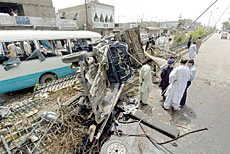
The attack targeting a minibus carrying 10 Chinese technicians occurred as their convoy was passing through the main bazaar in Hub, a town in the Balochistan province near the southern port city of Karachi. A moving car blew up next to a police vehicle escorting the foreign workers.
Hub police chief Ghulam Mohammed Thaib said seven police officers and 22 bystanders were killed. Another 30 people were wounded.
Maj. Gen. Saleem Nawaz, a commander of the paramilitary Frontier Constabulary, said the casualties could have been more. “It (the car) was laden with very heavy explosives, but due to our spacing and our security measures, the impact of the blast was less severe,” Nawaz told Dawn News television.
The police “sacrificed their lives and the Chinese friends were saved,” he said.
The blast ripped off the front of several roadside shops. Several damaged cars and buses lay rammed into one another among a tangle of bricks and clothing.
The force of the blast knocked over lorries and demolished nearby shops. “Suddenly I heard a powerful blast and smoke engulfed the convoy. I heard people screaming for help and body parts littered the area,” said witness Mannan Durrani.
“I saw flames all around me after a big bang. It appeared as if cars were flying in the air,” Mohammad Raheem, a 17-year-old laborer, who was injured in the blast, said from his hospital bed in Karachi.
“There were cries and screams all around. After that I don’t know what happened. I just fainted.”
Balochistan police chief Tariq Khosa blamed the attack on the same extremists who had been behind the spate of attacks since troops surrounded the Red Mosque on July 3. More than 100 died in the weeklong siege and subsequent assault. “Overwhelmingly it appears to be a backlash from extremists. The method of attack appears to be the same,” Khosa said.
Balochistan has also been wracked by a nearly three-year insurgency by tribal rebels seeking greater autonomy and a greater share of the province’s natural resources, although they have never used suicide bombs.
Key ally China asked Pakistan to step up security for its citizens two weeks ago, after militants shot dead three Chinese men in the northwestern city of Peshawar in revenge for the mosque siege.
The alliance with Beijing “is a vital relation for Pakistan but it appears that somebody wants to damage it,” said Foreign Ministry spokeswoman Tasnim Aslam.
In another attack, a man blew himself up at a mosque in an army cantonment in northwestern Pakistan, killing at least 15 people. The blast also wounded about 30 people. It happened during Isha (evening) prayers at Kohat, 150 km west of Islamabad.
“It was a suicide attack,” area police chief Zulfiqar Cheema said.
“The bomber blew himself up when evening prayers were in progress at an army mosque,” he said, describing a horrific scene where bodies were mutilated and “pieces of flesh and blood are inside the mosque.”
“The severed head of the suicide bomber has been recovered,” said Cheema, and a sketch was being drawn to help identify the man.
In the northwestern city of Hangu, a man blew himself up at a police training center killing at least seven people. He timed his attack to coincide with the arrival of a group of young recruits.
“The attacker tried to crash his car through the gate. He blew himself up as security guards at the gate tried to stop him,” said Fakhr-e-Alam, top administration official of the city.
Hangu, which itself has a history of sectarian violence, is close to the lawless tribal regions on the Afghan border, known to be hotbeds of support for Al-Qaeda and Taleban militants.
A large number of Al-Qaeda fighters and their allies fled to Pakistan’s tribal areas after US-led forces toppled the Taleban regime in Afghanistan in 2001.
At the same time as militants are believed to be taking revenge for the government’s mosque complex raid in the capital, pro-Taleban fighters have abandoned a 10-month-old peace pact in North Waziristan, raising fears of a resurgence in violence, mainly in the conservative northwest. Authorities yesterday sent tribal elders to the militants in a bid to salvage the pact.
The security situation has begun to weigh on Pakistan’s capital markets, suggesting it could soon threaten the strong economic growth that is one of Musharraf’s achievements.
The Karachi Stock Exchange’s main share index fell by about 3.4 percent yesterday, extending a slide begun the previous day, with analysts saying the violence scared off investors.
— Additional input from agencies