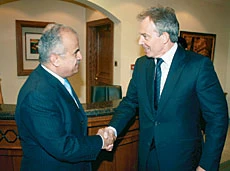
AMMAN/RAMALLAH, 24 July 2007 — Tony Blair, former British prime minister and the representative of the Middle East Quartet, yesterday kicked off his visit to the region with a flurry of meetings in Jordan and Israel. He began his visit with a meeting with Jordanian Foreign Minister Abdul Ilah Khatib. He later flew into Jerusalem and held talks with Israeli Foreign Minister Tzipi Livni and Defense Minister Ehud Barak.
According to a Jordanian government statement, Blair in talks with Khatib expressed his wish for “close cooperation” with Amman in the course of his new mission. Khatib told Blair that Jordan’s King Abdallah was involved in efforts aimed at “re-launching serious negotiations whereby the Palestinian and Israeli sides would be able to work out an agreement within a reasonable and limited timetable”, the statement said.
In Israel, Blair’s first stop was a meeting with Foreign Minister Livni, who said the visit was of great significance and that Blair’s mission — to strengthen the Palestinian economy and government — is an important step toward Palestinian statehood. “This is a critical point that can create a breakthrough,” she said. There were no immediate details on their talks.
Blair later met with Defense Minister Ehud Barak. Today he travels to the West Bank to meet Palestinian President Mahmoud Abbas and his prime minister, Salam Fayyad, then winds up his trip with a dinner at the home of Israeli Prime Minister Ehud Olmert.
Blair’s mandate has been defined by the Quartet — comprising the United States, the European Union, the United Nations and Russia — as concentrating on reform, economic development and institution-building in Palestinian territories. His visit comes amid a flurry of diplomatic activities aimed at bringing Israel and the Palestinians back to the negotiating table. US President George W. Bush called last week for an international peace conference on the Middle East in the autumn. Tomorrow, the Jordanian foreign minister and his Egyptian counterpart, Ahmed Aboul Gheit, are due in Israel to formally present an Arab peace initiative that envisions full Arab recognition of Israel in return for lands the Jewish state captured in the 1967 Middle East war.
Israeli and Palestinian officials have welcomed the involvement of Blair, but Hamas warned that his mission would fail if the movement is excluded.
Hamas spokesman Fawzi Barhoum said in a press statement that Blair’s mission “will fail and end without any achievements if not based on transparency and respect of all Palestinian political parties”. Hamas warned Blair not to ignore the group, and maintained that marginalizing Hamas would erode his credibility in his new position.
Another Hamas spokesman, Sami Abu Zuhri, said that his organization would be willing to talk with Blair, but not with Israel.