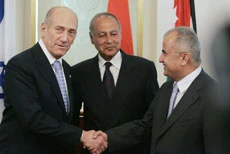
JERUSALEM, 26 July 2007 — Arab League envoys paid a historic visit to Israel yesterday to present a plan calling for a comprehensive regional settlement, saying they were extending “a hand of peace” on behalf of the Arab world offering the country “security, recognition and acceptance” by its Middle East neighbors.
Led by the foreign ministers of Egypt and Jordan, the delegation was taken deep into Israel’s political heartland, seeing the prime minister and the president and visiting the Parliament, bearing a proposal for full recognition of Israel by the Arab and Islamic world in return for Israel’s withdrawal from all lands captured in 1967.
While the Israeli and Arab officials greeted each other with smiles, jokes and what looked like genuine warmth, both sides acknowledged that the Arab League peace proposal cannot bypass direct talks between Israel and the Palestinians.
“This serious offer constitutes a major opportunity of historical levels,” Jordanian Foreign Minister Abdul Ilah Khatib said at a news conference alongside Israeli Foreign Minister Tzipi Livni and Egypt’s Ahmed Aboul Gheit. “It will provide Israel with the security, recognition and acceptance in this region which Israel has long aspired to.”
He said the plan was endorsed not only by the Arab League, but also by non-Arab Muslim states. Israel has welcomed the proposal as a basis for negotiations but says parts of it are unacceptable.
After pulling out of the Gaza Strip in 2005, Israel rejects a full withdrawal from the West Bank and East Jerusalem, hoping to retain areas heavily settled by Israelis, and strenuously objects to the plan’s apparent call for the repatriation to present-day Israel of Palestinians who became refugees in the 1948 Mideast war and their descendants — some 4.4 million people today, according to the UN. Israel says any large-scale influx of refugees would mean the end of Israel as a Jewish state.
Livni said the way forward was to look for points of agreement between Israel and the Arab world while seeking a bilateral solution to core issues such as the refugees and the status of Jerusalem.
“I think it would be a mistake today...to start arguing about every clause” of the plan, she said, pointing out that its central tenet, formation of an independent Palestinian state living in peace next to Israel, was shared by the Israeli government and moderate Arab states.
“We are not being asked to negotiate on behalf of the Palestinians,” Aboul Gheit said. “We will be helping both the Palestinians and the Israelis to negotiate among themselves.”
He cautioned against any expectation of a quick resolution to the dispute. “I don’t expect that we shall see a Palestinian state established tomorrow,” he said.
During the parliamentary visit later, the Arab ministers were hosted by the Foreign Affairs and Defense Committee, where they appeared to reassure even hawks.
“I am happy to say that after hearing our criticisms they said (the plan) is not an ultimatum, it’s not ‘take it or leave it,”’ said Yuval Steinitz of the opposition Likud party, a frequent critic of Egypt.
In an illustration of the often-bewildering complexities of Middle East diplomacy, there were differing views how exactly to define the delegation.
Israel presented the one-day visit as an unprecedented conciliatory gesture by the Arab League, which actively pursued the destruction of the Jewish state when it was established in 1948, refused to recognize it for decades afterward and suspended Egypt in 1979 for a decade after it become the first Arab state to make peace with Israel.
In recent years, however, many of the league’s member states have adopted a more conciliatory tone toward Israel, as they became more concerned about the rising influence of Iran and Al-Qaeda’s brand of extremist Islam.
The delegates themselves said they were sent by the Arab League and would report back to it next Monday. “We have been asked by the Arab League ministerial meeting to come and to offer Israel the Arab peace initiative,” Aboul Gheit told reporters during a visit to Israeli President Shimon Peres yesterday morning. Khatib later referred to “the mandate given to us by the Arab committee, assigned by the Arab summit, to follow up on the Arab peace initiative.”
An official at the league’s Cairo headquarters, however, sought to play down the Jerusalem visit, saying it was not an official delegation. Whether or not a delegation sent to Israel by the Arab League is in fact an Arab League delegation, the visit is part of a flurry of diplomatic efforts meant to restart Israeli-Palestinian peace talks after a seven-year lull. The international community’s Mideast envoy, former British Prime Minister Tony Blair, made his first trip in his new role to the region this week, and US Secretary of State Condoleezza Rice is expected next week.
Meanwhile, President George W. Bush on Tuesday met privately with Jordan’s King Abdallah who pressed him to intensify US efforts to jump-start peace negotiations between Israelis and Palestinians.
The two dined in the residence at the White House a week after Bush unveiled plans for a Middle East peace conference aimed at breaking the stalemate plaguing the region for years.
The meeting will be held later this year in the United States.
“King Abdallah urged the US to intensify its efforts in the coming weeks and months, particularly after Bush’s recent call for an international meeting to advance the peace process,” the Jordanian Embassy said in a statement.
Bush has promoted a two-state solution but numerous issues and problems have stymied those efforts.