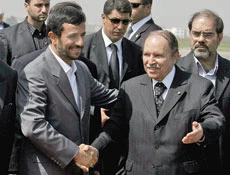
ALGIERS/TEHRAN, 7 August 2007 — Iranian President Mahmoud Ahmadinejad began a two-day visit to Algeria yesterday criticized by some media in the North African country as placing the US ally in the war against terrorism in an awkward diplomatic position.
Iran’s protracted nuclear dispute with the West was one of several items on the agenda of talks between the Iranian president and Algerian President Abdelaziz Bouteflika, Algerian state radio reported.
The visit is Ahmadinejad’s first to Algeria. He abruptly canceled a planned stopover in Algeria in January. The cancellation came after Ahmadinejad had suggested to Algeria’s energy minister that Iran could share its nuclear expertise with Algeria, an overture that caused concern in Algiers.
Algeria signed a deal on nuclear energy cooperation with the United States in June. Bouteflika met Ahmadinejad at Algiers airport and the two held talks later yesterday. No official information from the talks was released. Algerian state radio said they focused on the Iranian nuclear dispute, the war in Iraq, the possibility of a gas producers’ cartel, boosting economic ties, the Palestinian question and the disputed Western Sahara, a gas— and mineral-rich territory occupied by Morocco since 1975.
Ahmadinejad told Algerian reporters in Tehran before leaving that Algeria was a “brother country and friend, whose positions converge with those of my country.” He said his talks in Algeria would concentrate on issues “that require brother countries to cooperate,” without elaborating.
The visit follows a trip in June by Iranian Foreign Minister Manouchehr Mottaki, which Algeria’s state APS news agency said was aimed at securing Algerian support in the “Iranian nuclear crisis.” Algeria cut off diplomatic relations with Iran in 1993, accusing Tehran of supporting Islamic extremists. Algeria’s Army was battling an Islamist insurgency at the time that raged in the 1990s and continues to simmer. Relations were restored in 2002.
Meanwhile, Iran has closed down a prominent pro-reform daily three months after it reappeared on newsstands following a ban, its director said in Tehran yesterday, the second publication critical of the government to be shut since July. The closure of Sharq (East) coincides with what rights groups and diplomats say is a broad crackdown on dissenting voices in the Islamic state, which is under growing Western pressure over its disputed nuclear program.
Iran’s Press Supervisory Board banned the daily with immediate effect because of an interview with a poet who has written about homosexuality, the Fars News Agency said. Homosexuality is a crime punishable by death in Iran, which has implemented Islamic Shariah law since the 1979 revolution.
Sharq’s Managing Director Mahdi Rahmanian suggested the authorities had looked for an excuse to close it down. He said the daily had only found out later there were “moral problems” involved in interviewing the female expatriate poet.
The article itself, published on Saturday under the headline “Feminine language,” did not explicitly touch on homosexuality. Sharq still published an apology yesterday for running the article and said it had been withdrawn from its Internet site.
“This is not something to close a newspaper for,” Rahmanian told Reuters. “Closing a newspaper for which 400 people worked because of the first mistake it did shows they were closely monitoring us to use the first mistake as a pretext to close it.”