
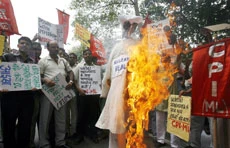
NEW DELHI, 15 August 2007 — Prime Minister Manmohan’s meeting with Communist Party of India-Marxist (CPI-M) General Secretary Prakash Karat yesterday failed to break the impasse over the India-US civil nuclear agreement as the left parties again rejected the pact saying it would impact on India’s foreign policy.
Manmohan met Karat over breakfast and “specifically allayed left’s fears of India’s foreign policy being in any way influenced by the Indo-US nuclear cooperation pact.”
“Karat and the prime minister reiterated that efforts would be made to sort out the issues,” Sanjaya Baru, the prime minister’s media adviser, said in a statement to the media.
Karat told the prime minister that some of the points regarding the agreement, which were discussed during the meeting, would be taken up by the party’s politburo over the weekend. External Affairs Minister Pranab Mukherjee was also present at the meeting.
Hours after the prime minister met Karat, the CPI-M issued a statement reiterating its key objections to the nuclear deal and its link with India’s foreign policy.
“The prime minister’s statement in Parliament does not shed any new light on the India-US nuclear agreement that calls for a reassessment on our part. He has reiterated his position on the agreement and has not addressed the issues that we have raised,” the politburo of the CPI-M said in its statement.
“The CPI-M reiterates its stand that the government should not proceed with operationalizing the bilateral agreement.”
The party stressed that “the issue was not what the prime minister is saying but what his government was doing” with the US which will impinge on the country’s foreign policy. “The Defense Framework Agreement of 2005, the Logistics Support Agreement being negotiated currently, joint naval exercises being planned and the stand on the Iran nuclear issue are there before us,” it said.
“Therefore, it is difficult to agree with the prime minister that this agreement has no impact on our independent foreign policy, especially when the US officials are busy selling the agreement to the US Congress on the strategic value of India aligning with the US as a consequence of the agreement,” it said.
The CPI-M, which leads the left combine including the Communist Party of India, Forward Bloc and Revolutionary Socialist Party, singled out the certification clause in the Hyde Act. It said that although this clause was missing from the 123 pact, in practice it could lead to the termination of civilian nuclear cooperation between the two countries.
“A simple reading of constitutional practice of the US would clarify that this annual certification is an obligation of the US president, which he is bound to fulfill,” the party said. “That it does not find a place in the 123 agreement is not relevant. The issue that we have raised is if a ‘good conduct certificate’ is not forthcoming or if the US Congress does not accept the good conduct certificate given (on issues ranging from Iran to anything that may come up in the future) what would be the implications for the 123 agreement? In our understanding, the US could terminate the agreement with all its consequences for our civilian nuclear energy program,” it added.
The party also questioned the prime minister’s assurances that the 123 pact ensures uninterrupted fuel supplies for Indian reactors by providing for the development of a strategic fuel reserve.
It sought to punch holes in the government’s claim of enabling full civil nuclear cooperation contenting that the 123 pact denied full access to technology for the fuel cycle — a reference to the US denial of technologies related to uranium enrichment, heavy water reduction and reprocessing under the 123 pact.
“The prime minister has essentially confirmed this; the only concession finally secured is ‘forward-looking language’. The prime minister has also emphasized the gains made with regard to the right to reprocess spent US fuel. However, this is only a notional right at present and subject to conditions that may emerge in the future.”

