
GAZA CITY, 16 August 2007 — In an apparent attempt to limit Hamas’ participation in new elections, Palestinian President Mahmoud Abbas is looking at different options including a change in poll law, sources close to the presidency said yesterday.
One of these options would bar candidates from Hamas and other groups from participating unless they accepted Palestinian law and previous agreements signed by the Palestine Liberation Organization (PLO).
Abbas’ advisers, who spoke on condition of anonymity, stressed that no final decisions have been made.
Hamas, which won a majority of the seats in Parliament in January 2006 elections, has said it would be unconstitutional for Abbas to call early parliamentary and presidential elections. The group has threatened to block any election effort.
The long-dominant Fatah faction of the PLO, then led by Yasser Arafat and now headed by Abbas, recognized Israel and dropped its commitment to “armed struggle” on signing interim peace accords with Israel in 1993.
Hamas refuses to renounce violence and says it will not recognize Israel as demanded by major Western powers.
Hamas leaders have offered a long-term truce with Israel in return for a Palestinian state in the occupied West Bank and the Gaza Strip.
Nimer Hammad, an aide to Abbas, said there was a “serious discussion” under way about how to hold parliamentary and presidential elections despite opposition from Hamas who seized control of the Gaza Strip in June.
“Until now, no position has been taken,” Hammad said, but added: “Whoever wants to run for elections must abide by Palestinian law.” Another Abbas aide, who asked not to be identified, said: “There are preparations for elections and the president is now studying the options that are available to him.” Abbas said in a recent interview that he would decree a change in Palestinian electoral rules that might make it harder for Hamas to maintain the parliamentary majority won last year.
Abbas also said parliamentary and presidential elections must be held simultaneously in the West Bank and Gaza Strip — a condition that leaves the timing uncertain, given the opposition of Hamas leaders. Legislative elections are not scheduled until 2010 and some constitutional experts note that the Palestinian Basic Law, which functions as an interim constitution, has no provision for calling early elections.
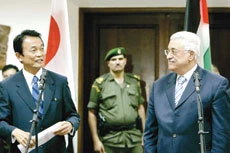
In another development, Japan resumed direct financial aid to the Palestinians yesterday when Foreign Minister Taro Aso signed a multimillion dollar aid package for the Western-backed government.
Aso signed the deal with Prime Minister Salam Fayyad in the West Bank town of Ramallah as he continued a regional tour which Tokyo has said aims to promote the peace process through economic means.
“The deal provides direct aid from the Japanese government to the Palestinian Authority in the amount of $11.3 million for the general budget, support for an agriculture project and other economic sectors,” a senior Palestinian official said.
Japan, the world’s second-largest economy and a major donor to the Middle East, will provide another $8 million in humanitarian aid, the official said.
Japan suspended direct aid to the Palestinians in 2006 after Hamas formed a Cabinet.
“Since the creation of the Palestinian Authority (in 1994), Japan has given a billion (dollars) and today we thank it for this new aid of $20 million,” Abbas told Aso.
After Ramallah, Aso attended a four-way meeting in Jericho with Israeli Foreign Minister Tzipi Livni, Jordanian Foreign Minister Abdul Ilah Khatib and chief Palestinian negotiator Saeb Erekat to discuss a project for an agro-industrial park in the Jordan Valley that Japan is underwriting.
The sides agreed to conduct feasibility and environment studies to determine the location and way of operation of the joint project for Israel, Jordan and the Palestinians, an Israeli Foreign Ministry official said.
“Japan, which has gained the trust of both the Arabs and Israelis, understands that the only solution in the Middle East is the establishment of peace and coexistence between Palestinians and the Jewish state,” Aso said in Jordan where he began his tour.
“This project will help create jobs for the Palestinians, boost their economy, build confidence with the Israelis and establish friendship between parties of the peace process,” Aso said, speaking through a translator.
“In order to establish a Palestinian state, it must be economically viable, and we are presenting the initiative of the ‘corridor for peace’ as a means for this economic viability,” he said.
Aso on Tuesday met senior Israeli officials in Jerusalem.
In talks with Livni, Aso urged Israel to ease the severe restriction on movement that the Jewish state has imposed in the occupied West Bank, citing security concerns, since the start of the second Palestinian uprising in 2000.
“I asked my colleague to continue peace efforts, especially in reducing the roadblocks in the West Bank and dismantling illegal (settlement) outposts,” Aso said.
Japan has tried to increase its visibility in the Middle East in line with its aspirations for a greater global role.
— With input from agencies

