
The “desert kingdom” cliché that is frequently used in the international media to describe Saudi Arabia does not, in the best traditions of clichés, describe the whole picture. With a national average of 112mm of rain precipitation per annum, much of the Kingdom falls within the standard definition of desert as an area with a precipitation rate of less than 250mm per year.
However, parts of the Kingdom far exceed this. Levels as high as 600mm per annum are a regular feature of Asir in the southwest with occasional peaks of nearly a meter. Manchester in the UK, traditionally thought of as Britain’s wettest city (whereas in reality it is Swansea with up to 11,422mm of rain per annum) and something of a stereotype for continuous rain, averages 809mm per annum, trailing Asir’s peak precipitation levels.
The truth is that there is a great deal of water in the Kingdom but much of it is underground. The threat of Saudi Arabia running out of water in 20 years or so is a specter to be contended with. With good management and some insightful government action, that deadline could be, however, extended by decades or perhaps even removed.
Reserves need very careful husbandry; some such as the Umm Ur’Radhuma in the Eastern Region running down to NADEC in Haradh and to Yabrin are being recharged fairly actively.
There is no point, however, rationing water that should not be extracted in the first place. One solution would be to place the country into zones, to only allow extraction from rechargeable areas, and to severely limit or ban extraction in others.
Some, such as the Saq — which runs into Saudi Arabia from Jordan, reaching Jouf and Hail — go very deep toward Shari (halfway between Hail and Qassim) and are being recharged from the north. The sources are thought to be the Bakar Valley or even as far away as the Balkans or under the Mediterranean.
That said, formidable challenges remain. According to the water industry’s monitor Global Water Intelligence (GWI), Saudi Arabia has annually renewable freshwater resources of 2.4 km3/yr of which 1-km3 percolates into accessible aquifers as replenishment.
The Asir region in particular is developing its rainwater and run-off harvesting apace with dams under construction. They should capture enough water to bring some 15,000 hectares of new agricultural ground into being. Currently, if just a quarter of the water lost by run-off could be harvested, it would supply all of Saudi Arabia’s current agricultural needs.
Saudi Arabia uses 22 km3 of water per year. To make up the difference between the rate of annual renewal and the Kingdom’s water use, water is extracted from nonrenewable reserves or provided by desalination.
Looked at another way, for every 9 liters of water used in Saudi Arabia, only one is annually renewed; the rest comes from declining nonreplaceable reserves or desalination.
Keeping urban areas supplied with water is an increasingly pressing problem as the customary temporary suspension of services in municipal supplies and the regular merry battles to secure tanker deliveries from water plants indicates. Coupled with the decline in groundwater supplies are the additional factors of pollution of aquifers by the conurbations they serve, and the fact that desalination plants are nearing the end of their productive lives.
The plants at least can be replaced — the Shuaiba plants to the south of Jeddah and the Ras Azzour plant north of Jubail on the east coast will go some way to addressing some of the demands of Jeddah and Riyadh respectively.
Investment in water production is at a historical high with the rapidly diversifying economy, high birth rate, and the construction of major industrial cities and economic zones.
This challenge is being met through increased investment in water production facilities with the privatization of the Saline Water Conversion Corporation (SWCC) and by contracting relevant management skills from outside the Kingdom.
On the demand side, managing the consumption of water is a particularly intractable problem. Per capita abstraction of water, including agriculture, is 2,893 liters per day and public supply 237 liters per day — high by international standards and about twice the European average. According to official sources, water demand in the Kingdom is growing by six percent a year, currently standing at 5.7 million cubic meters a day (cmd) and reaching 10 million cmd within 15 years.
The cost of water in Saudi Arabia is among the highest in the world. Desalination is part of the cost but the transport across long distances — Jubail-Riyadh, Shuaiba-Jeddah — adds to the price. High levels of “unaccounted for water” (UFW) — officially 31 percent — increase the production unit price on delivery still further. Just last Tuesday, addressing severe leakage problems, the Ministry of Water and Electricity (MOWE) announced a SR1 billion program to address the problem of UFW.
To make inroads into this, campaigns to conserve water have been actively promoted by MOWE. However, what might prove to be the most effective method for handling demand, pricing policy, still remains a nettle no one wants to grasp. It is also a stumbling block to inward investors who expect to make a reasonable return on their investment.
Of the many water challenges that face the Kingdom, water use in agriculture tops the list as the biggest and probably the most inefficient user. In its charge toward self-sufficiency in food, it has cost water reserves dearly. Started in the late 1970s and funded by money accumulated from the first oil boom, the wheat program cost the government an estimated SR60-70 billion ($16-18.7bn) over the years. The government abandoned the idea in January 2008 and has said that it aims at importing its entire wheat requirements by 2016.
Looking in closer detail at the internal structure of agriculture and the mechanism of production, a hidden challenge of potentially prodigious proportions rises in the form of alfalfa. Relieved of their subsidized income from wheat, farmers moved to supplying the Kingdom’s large dairy industry with alfalfa, a forage crop.
The quality of Saudi alfalfa is extremely good — as one expert believes, the best in the world. This is evidenced by the output from one of the Kingdom’s major dairy herds; 13,500 liters of milk per head over a 305 day yearly cycle. That is approaching twice the European yield at 8,000.
The lurking menace is triple horned — alfalfa uses three times as much water to yield a crop, the water is almost exclusively drawn from nonrenewable sources, and the methods of irrigation used are remarkably inefficient — 40 percent or more of the water mined is lost either from leaking pipes or by evaporation from inefficient spray-application to growing crops.
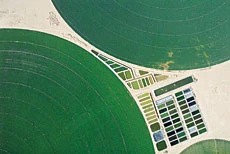
Agriculture accounts for between 80 and 90 percent of water use in Saudi Arabia. Much of it is being wasted. The culprits are pivot spray irrigation devices that produce the characteristic crop circles visible as dark green circles from the air.
“Most of the time they act as the biggest desert coolers in the world,” quipped John Lawton an agricultural engineer in Riyadh. “Using the high pressure spray method causes 40 to 50 percent to evaporate before it gets to the ground.”
Lawton said that current Low Energy Precision Application technology (LEPA) allows water application at low pressure (below 15 psi) through a sophisticated system of jets that produce large droplet sizes, which is the most efficient use of surface area per unit of mass, very close to the ground.
“This could reduce loss by 80 or 90 percent and still use the center pivot system,” he said. Ironically, LEPA technology is available in the Kingdom, but very few producers use it.
Turning to “row crops”, Lawton said water savings could go as high as 90 percent. Row crops — those grown in rows, for example tomatoes or wheat — could be planted in circles with the pies extending to end in nozzles that drag along the ground drip feeding water to precisely where it is needed. Again, the technology is in the Kingdom; again, few are using it. A simple solution available to the government is to legislate for LEPA technology to become the industry standard, and for leakages from pipes and pivots to be minimized and contained.
Saudi Arabia has reserves of water. Introducing appropriate conservation technology, legislation, enforcement and skilled management can allay many of the challenges concerning their use and conservation. Whilst nonrechargeable aquifers have by definition a limited life, their depletion can be minimized while the Kingdom develops its industrial base and knowledge economy.
The moral imperative for consideration might be; it is possible to grow water intensive crops in a desert area but for the long-term water security of the country, should you?