
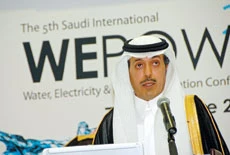
DAMMAM: Privatization and the challenges of financing topped the agenda of the first business day of the fifth International Water, Electricity and Power Generation Conference and Exhibition in Dammam yesterday. Almost without exception speakers and panelists were entirely positive about the long-term benefits of privatization and public-private-partnerships to build and manage the massive infrastructure the Kingdom need to keep pace with its demographic and industrial expansion. The negative notes were low key — cautionary rather than oppositional.
The National Water Company (NWC) CEO Loay Al-Muallam set the tone of the proceedings with a review of the activities of the two-year-old NWC, a wholly government-owned organization tasked with building and overseeing the environment for all aspects of water privatization. The organization is responsible for managing the development of public private partnerships and all aspects of privatization. Noting a sea change in government thinking about water management he signaled a different approach to the subject of water in the Kingdom.
“We cannot meet the challenges presented in the water sector by continuing as it is,” he told delegates, adding that this was the driving precept for reform. He catalogued the NWC’s progress since it began operations in June 2008, noting that the plan had been to allow five years for transition from public to private.
“We have actually achieved most of what we want in one,” he said. This included absorbing 6,000 government employees “the expectations that we could solve all the problems of the last 40 years.” They came with their own culture, problems with efficiency and performance. He noted that one of the more pressing needs was “investment in training.” With the transfer of the workforce came 186 projects worth some SR24 million.
NWC has within its mandate the responsibilities of underground water, production, treatment and desalination. It was capitalized with $5.9 billion and has started its operations in Riyadh and Jeddah but looked to operate in 15 cities within three years.
He identified several of the challenges facing the NWC in his review, among them the need for financial restructuring as the sector was still heavily subsidized, the gap between supply and demand and the opening of the sector to competitors. He identified the area of treated sewage effluent (TSE) as on that could be usefully addressed.
The Kingdom’s relatively secure financial status during the global credit crunch was central to panel discussion that looked at the availability of credit financing for the huge capital projects of the next two decades. George Sarraf, principal of Booz and Company, opined: “Most economists believe we are at the end of it and it will finish in two or three years.”
Rayyan Nagadi, associate director for project finance at HSBC, agreed saying that the banking sector had kept pace in terms of liquidity to match projects. The markets were stabilizing and liquidity picking up but the key to financing was “a well structured and viable project” and that feature attracted banks.