
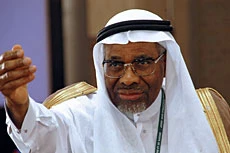
JEDDAH: The Islamic Development Bank (IDB) plans to issue $6 billion worth of Sukuk over the next five years in order to finance its programs, the bank president said.
While addressing a press conference at the IDB headquarters here yesterday, Ahmad Mohamed Ali said a $500 million Sukuk would be launched within a few weeks followed by another $500 million.” He also said the bank was planning to issue $1.25 billion worth of Sukuk every year for the next five years.
“The new Sukuk will increase the IDB’s financing program by 30 percent,” he added.
The global economic crisis, the most serious during the past 50 years, has changed the development landscape. “The longevity of the crisis is a source of concern because of the magnitude of its impact with varying degrees on the economies of many member countries,” Ali said, adding they are adversely affected by job losses, shrinking remittances and development assistance, and declining world trade.
Ali said the IDB, which aims to foster economic and social development in its 56 member states, had a number of programs to help alleviate poverty.
He also said during the 34the annual meeting of the IDB board of governors in Ashgabat, Turkmenistan at the beginning of this month, that the governors had given approval to raise IDB financing by 30 percent for three years because of the ongoing economic crisis. Earlier it was aimed at increasing by 15 percent.
The IDB Group has significantly increased its project financing in member countries totaling $3.1 billion in 2008, a growth of 17 percent over the previous year. The overall financing for public and private sectors in member countries grew by 5 percent to $5.7 billion.
Despite the global financial crisis, IDB maintained its highest ratings of “AAA” assigned by Standard & Poor’s, Moody’s and Fitch for the seventh consecutive year, Ali said. “Amidst the crises, the IDB Group is repositioning itself to face the challenges and become a world-class institution,” he added.
Launching the first annual report of the Islamic Solidarity Fund for Development (ISFD), Ali, who is also the chairman of the board of directors, said the year 2008 was the first year of operations of the ISFD. It was the year of laying the basic foundation for the fund — drawing up new policies for poverty reduction, deciding the strategic thrust and priority sectors for maximizing the impact on poverty reduction, developing guidelines under which the fund would operate, and setting procedures for effectively carrying out its mandate. “We appreciate the generous contributions received so far for the fund and urge other member countries to contribute for the benefit of the least developed member countries,” Ali said.
He said extra effort would be needed to raise the $10 billion initially targeted capital of the fund.
So far, 36 of the member countries have pledged $1.61 billion, in addition to $1 billion committed by the IDB.
When asked when an end to the present financial crisis could be expected, Ifzal Ali, chief economist at IDB, said the crisis in G-7 countries had triggered a synchronized global downturn.
“The world economy is projected to shrink by about 3 percent this year. This is the first time this has happened in the last 60 years. Likewise, an 11 percent decline was forecast in the volume of trade in 2009. This is what is having a ripple effect around the world and what makes it very difficult to predict an end to the crisis.”