
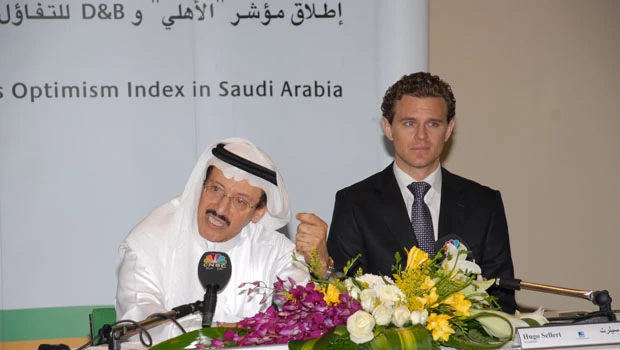
- JEDDAH: There is a broad improvement in Saudi business sentiments indicting that economic recovery is on track.
- Some of the highlights of the recovery after the worldwide economic slowdown are that firms across all major industry sectors in the Kingdom are upbeat on sales and order book status, an increased share of companies expect the level of selling prices to rise and the hydrocarbon sector is about to resume hiring following a decline in 2009.
These are among the findings of Q1, 2010 of the Business Optimism Index (BOI), following a survey by the National Commercial Bank, in association with Dun & Bradstreet South Asia Middle East Ltd. (D&B), Dubai. The survey was conducted in late December 2009 amid an environment of relatively buoyant commodity prices and renewed expansion in economic activity around the globe.
Growth in global manufacturing and services industries at the end of last year has also helped restore oil prices. With increased hydrocarbon revenues, governments across the Gulf have been able to extend stimulus measures to support the burgeoning economic recovery.
In Saudi Arabia, the recently announced budget allocation of SR260 billion toward capital expenditure in 2010 will continue to provide growth impetus to the country going forward.
There are also some early signs of liquidity returning back to the Saudi market, reflecting the accommodating monetary stance of Saudi Arabian Monetary Agency, NCB's Senior Vice President & Chief Economist Said Al-Shaikh and Hugo Sellert, economist at Dun & Bradstreet South Asia Middle East Ltd., said at a joint press conference.
The latest BOI findings reveal that sentiments have continued to improve in Q1 across all major sectors of the Saudi economy. In the non-hydrocarbon sector, firms are increasingly optimistic regarding the volume of sales and new orders outlook, indicating demand is continuing to strengthen. Expectations have also firmed, for a third consecutive quarter, regarding the level of selling prices with 43 percent of respondents expecting increases during Q1.
In the hydrocarbon sector, a major jump has been seen for the number of employees parameter, suggesting oil and gas companies intend to resume hiring on the back of recovery in oil prices over the last year. The elevated optimism levels regarding net profits have been maintained in Q1.
"The profits achieved by Saudi companies in Q4, 2009 gave a boost to the continuous improvement in business sentiments in Saudi Arabia which was reflected by the quarterly business optimism index since mid last year. By reading the index and analyzing the systematic and continuous trend drawn from the results of the last three quarters, we can fairly say that we have reached a stage of relative stability in the macroeconomic outlook of Saudi Arabia after the global financial crisis," Al-Shaikh said.
"As we see a revival in global trade and a gradual return of cross-border investments and flows of liquidity among capital markets, the prevailing atmosphere of optimism among the Saudi business community reveals a relatively constant trend, but one that has important implications to the recovery of our domestic economy.
This trend is partly charted by the expansionary fiscal policy pursued by the Saudi government, which had a pronounced impact in continuing to stimulate the local economy and enhance the confidence of businesses in the oil and nonoil industries," he added.
The report also shows that among the five industry sectors surveyed in the non-hydrocarbon segment, manufacturing is most optimistic with respect to net profits, level of selling prices, number of employees and level of stock, indicating renewed momentum in the Kingdom's goods-producing sector.
Backed by the improving economic outlook, 46 percent of the Saudi business community surveyed expects to invest in business expansion during Q1, a moderate improvement from 40 percent in Q4, 2009. With respect to borrowing conditions, 77 percent of Saudi businesses expect them to improve or remain unchanged during the current quarter.
"The latest results of the BOI show that Saudi companies are increasingly optimistic about near-term business prospects," said Sellert.
"With the pick-up in global economic activity and continued government spending and investment in key areas such as infrastructure, more and more firms are now ready to resume investing in business expansion, paving the way for solid growth this year."
The report also shows that a majority of non-oil businesses remain concerned about the cost of raw materials, with 56 percent of respondents citing it as the main factor affecting business. In the hydrocarbon sector, project delays have been most often cited as the main concern facing businesses.
The D&B BOI is widely recognized as a key measure of the pulse of the business community, serving as a reliable benchmark for investors, policy makers and other observers of the economy worldwide. As the latest addition to D&B's global series, the BOI on Saudi Arabia, done in association with the NCB, is issued on a quarterly basis. The next BOI on Saudi Arabia will be released in April.